Monday, March 20, 2023

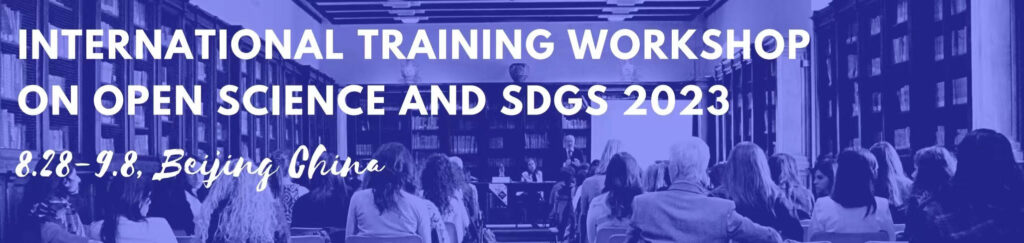
International Training Workshop on Open Science and SDGs 2023 (In-Person)


The International Training Workshop on Open Science and SDGs 2023  is now open for application! As a feast of knowledge sharing, this year's onsite training will be arranged in Beijing, China, on  28 August  – 8 September, 2023. This years' edition of the training workshop is planned as an in-person event.

The deadline for applications is 11:59 am CST (UTC+8) on 14 May 2023.

Facing the grand challenges in the 21st century, open collaboration and open science among global stakeholders are vital to ensure a healthier and more sustainable planet for generations to come. As a direct response to the UNESCO Recommendation on Open Science and the Sustainable Development Goals (SDGs) of the United Nations, the idea to co-design and co-build the Global Open Science Cloud (GOSC) was proposed during the CODATA 2019 Beijing conference. Officially inaugurated in 2021, GOSC aims to encourage cooperation, alignment, and ultimately interoperability among worldwide open-science research clouds/platforms/initiatives, so as to tackle the major global scientific and human challenges. As a global initiative, GOSC highlights the importance of capacity building for open science and SDGs, with yearly international training programs launched to fulfil its obligations for international collaboration and alignment.

This year, CAS is cooperating with CODATA (and in particular its GOSC Initiative) and CBAS to support the International Training Workshop on Open Science and SDGs 2023. The upcoming event will be facilitated by CNIC, CAS (convened by the GOSC IPO), Chinese National Committee for CODATA, CAS-TWAS SDIM, and WFEO CDRM. Uniting the joint efforts of these organisations, the 2023 International Training Workshop will focus on generic knowledge and skills for open science as well as best practices across domains for SDGs. Qualified trainees will receive funding support to attend the onsite training (28 August – 8 September, 2023, Beijing, China).

See https://ostraining2023.casconf.cn to learn more about the training methods and themes, eligibility and the application process.

Sunday, March 19, 2023

Call for Papers: 20th Anniversary Globelics International Conference 2023 | Kerala, India

20th Globelics International Conference 2023
Theme: Innovation-Driven Knowledge-Economies and Transformation in the Global South
12-14 October 2023
Thiruvananthapuram, Kerala, India
Deadline for the general submission of papers: 30 April 2023


Call for Papers
The Globelics network was started twenty years ago with the first international conference held in Rio de Janeiro in 2003. The main aim of the Network was to focus on Learning, Innovation and Competence-building Systems (LICS) to understand the nexus between innovation and development. This 20th anniversary conference will use the opportunity to reflect on insights generated by the network and the future research agenda.
Episodes of development in economic history highlight the successful experience of countries that have managed to harness Learning, Innovation and Competence Building Systems at the global, national, subnational and sectoral levels to transform their social and economic structures for achieving prosperity. In current times, the constellation of innovations driven by rapid advances in digital technologies have given rise to a new technological revolution (commonly referred to as the fourth industrial revolution, or Industry 4.0) with profound impacts on all sectors of the economies and sections of societies. New and persisting developmental challenges have driven a renewed interest in types of innovation that highlight their impact on society and the natural environment, such as inclusive innovation, responsible innovation, transformative innovation, grassroots innovation and jugaad. At the core of all these approaches is how knowledge, both science-based and experience-based, is harnessed for addressing development challenges. The basic premise being the knowledge divide is at the root of the development divide.
At the current juncture wherein, globalisation is at a crossroads and the economies across the world, ravaged by the once in a century pandemic and external shocks, consider strengthening the innovation system as a strategic approach towards building resilience. Evidently, there is an across-the-board drive among the developing countries to transform their economies into innovation-driven knowledge economies. Such a transformation is often viewed as capable of building resilience by addressing many of the downsides of globalisation-induced high growth, like excessive exploitation of exhaustible resources and accentuated divides within and between countries. While such initiatives in India are manifested in Atal Innovation Mission (AIM), Digital India, Skill India, and Make in India, among others, in Kerala, the development strategy has been explicitly reoriented in terms of transforming the state to a knowledge economy. It is against this background that Globelics revisits India for the 20th Globelics International conference with the chosen central theme 'Innovation-Driven KnowledgeEconomies and Transformation in the Global South'.
The 20th Anniversary of Globelics is also an occasion to celebrate the journey of Globelics from Brazil 2003 to India 2023 and its varied achievements. At the same time, it is also a forum for critically reflecting on our perspective and the approaches inter alia in terms of its achievements and limits. This is especially important at the current juncture wherein there is growing disenchantment with the development experience under globalisation on the one hand and the need for reimagining the innovation system in the COVID and Post COVID world towards building the much needed resilience in the South. The selection of Kerala, which is known for its unique development experience (so called Kerala Model of development), as the location for such a deliberation could not have been more appropriate.
Globelics-India 2023 coincides with India's Presidency of G-20, which provides immense scope for translating the outcomes of the conference into policy action. In the past two decades, we have observed the increasing presence of Global South in shaping the paradigms and trajectories of global development agenda— sustainability, climate change, pandemic, energy security issues—all being closely linked to the research domains of the Globelics.
The 20th Globelics Conference intends to bring together scholars across disciplines from different parts of the world to pool together experiences and expertise to reflect on varied issues involved in transforming developing economies to sustainable, resilient and inclusive innovation-driven knowledge economies.
World-leading scholars will give this year's keynote address on innovation and development, and it is planned that the conference will be inaugurated by The Chief Minister of Kerala (to be confirmed). There will be a special keynote on the conference theme along with Globelics Lecture and Freeman Lecture. The conference will combine plenary sessions, presentations of research papers in parallel tracks, thematic panel sessions or special sessions, poster presentations, book presentation sessions, excursions and cultural events.

Conference Tracks
While we encourage submissions on the central theme of the conference, submissions on all the issues conventionally deliberated in the Globelics international conferences are also welcome. However, it is requested to articulate the issues by keeping in mind the broad theme of the conference.
Submissions are welcome on issues around the following themes:
1. Science, technology, innovation: Theory and policy for a knowledge economy
2. Transformative innovation, responsible innovation and mission-oriented innovation
3. Knowledge-driven development of national, regional, local and sectoral innovation systems, including Agricultural innovation systems and rural development
4. Measurement of the knowledge economy: Indicators, data requirements, different approaches and methodologies
5. Skilling for the knowledge economy: Industry-academy interaction, Intellectual property rights, open innovation and development
6. Industry 4.0 and development: Digitalization and automatization, productivity and employment implications, gig economy and quality of employment
7. Economic and social upgrading for sustainable Catch-up: trade policies, FDI, value chains and innovation networks in a knowledge-driven economy
8. Innovation for inclusive development: Indigenous knowledge, Grassroot innovations, Jugaad, informal economy, micro and small enterprises
9. Entrepreneurship, employability and gender dimension in innovation and development
10. The green economy and financing innovation: Low carbon innovations, environmental technologies and renewable energy

Special Sessions: Those interested in organising special sessions are also encouraged to submit their proposals

Conference Organisers: The conference is organized jointly by the Gulati Institute of Finance and Taxation (GIFT), Indian Institute of Management Bangalore (IIMB), and Research and Information System for Developing Countries (RIS) New Delhi, Kerala Development and Innovation Strategic Council (K-DISC), Indialics and the Globelics Scientific Board in association with Digital University of Kerala (DUK) and Higher Education Council of Kerala. The conference will be hosted by Gulati Institute of Finance and Taxation (GIFT), Thiruvananthapuram Kerala, India.
We encourage scholars at scientific institutions, universities, enterprises and public sector institutions to take this opportunity to present their research papers on the conference theme or on any of the conference tracks. We especially encourage young researchers and researchers from low-income or developing countries to submit papers, Papers for oral presentations and poster presentations must be written in English, and the selected ones must be presented at the conference in English.

Paper Submission not later than 30 April 2023 
Submission of full paper (in PDF) not exceeding 12,000 words (including notes, tables, appendices, list of references, etc.) should be made via the online submission form available at Globelics website which will be open by late February 2023. Papers must be submitted before 30 April 2023.
The selection of the papers is based on a peer review process that focuses on relevance, academic quality and originality. Globelics reserves the right to use available software to control plagiarism and to take appropriate action in such cases.
  • Deadline for the general submission of papers: 30 April 2023.
  • Acceptance notification for all other countries: 31 May 2023
  • Deadline for application for travel support: 15 June 2023
  • Response to applicants for travel support: 15 July 2023
  • Conference registration open: 1 August 2023
  • Conference registration close: 20 September 2023
  • Last date for upload of final version of papers: 15 September 2023
  • Conference dates: 12-14 October 2023
PhD students are welcome to enter the PhD students' paper competition. Winners will be announced during the Conference. You can follow the preparation of the conference on the Globelics website.

Travel Support and Hospitality: All those submitting papers are encouraged to mobilize travel support by themselves. The Globelics Scientific Board (GSB) will make efforts to mobilize resources for offering travel support for those from the low and lower middle-income countries. The support available will be contingent on availability of funds. Faculty members and PhD students from low and lower middle-income countries can apply for travel support. Travel support is given as reimbursement after the conference based on ticket stubs directly from the Globelics Secretariat. Application for travel support must be submitted along with your paper sub submission. Please note that the offer for travel support is contingent on the availability of funds. Further information on the procedure for travel support application will be available on the conference website.
All the participants will be offered hospitality for four nights: Arrival 11 October 2023 and departure 15 October 2023
Fwd: Call for Abstracts: 28th Nordic Workshop on Bibliometrics and Research Policy, October 11-13, 2023

---------- Forwarded message ---------
Dear Colleague,


Greetings from Gothenburg!


The 28th Nordic Workshop on Bibliometrics and Research Policy (NWB2023) is scheduled from October 11-13, 2023. The Department of Communication and Learning in Science at the Chalmers University of Technology will host the NWB2023 in Gothenburg, Sweden. This workshop has been a consistent and enduring practice within the bibliometrics community for nearly three decades. It aims to promote the convergence of bibliometric research with research policy, highlight the latest bibliometric research activities from the Nordic region and beyond, and enhance the ties between bibliometric research groups and their PhD students.


Participants who wish to present their research with a Nordic audience and beyond are encouraged to submit a 250-word abstract in the prescribed format. If an abstract is accepted, the authors (at least one) must register for the event and attend the workshop in person. The workshop is open to participants worldwide and will be conducted in English. There is no cost associated with registration; however, participants must cover their travel and accommodation expenses.


Important dates

Submission of abstracts (posters and papers): April 3 – May 19, 2023.
Notifications of acceptance: June 21, 2023.
Registration: June 22 – July 20, 2023.
Nordic Workshop: October 11 – 13, 2023.


More information is available at https://nwb2023.lib.chalmers.se
Feel free to contact us at: nwb2023@chalmers.se
Follow us at twitter.com/nwb2023
Hashtag on social media: #nwb2023


Best regards,


On behalf of the organizing committee of the NWB2023


Jakaria Rahman,PhD

Bibliometric Analyst
Division for Information Resources and Scientific Publishing

Dept. of Communication and Learning in Science

Phone:  +46 (0)31 772 6917

ORCID: 0000-0001-7876-4631

Chalmers University of Technology

Hörsalsvägen 2
SE-412 96 Gothenburg, Sweden

www.chalmers.se

jakaria[@]gmail.com

Tuesday, March 14, 2023

[apeid.higher_education.bgk] Join us on 15 March - Building a Community of Practice: Learner-centred teaching in TVET in Asia-Pacific

Dear Friends and Colleagues,


We are thrilled to bring together a great list of speakers and offer opportunities for networking from 15.00 – 16.30 Bangkok (GMT+7) on 15 March.


Join the presentations and discussion as we look ahead together.


Please do share the news further!


Wesley Teter


---

Building a Community of Practice: Learner-centred teaching in technical and vocational education and training in Asia-Pacific

UNESCO Bangkok is pleased to announce the release of a new report to counter the impacts of COVID-19 and promote a learner-centred approach to TVET teaching that builds skills for life and work.

Join us online for the report launch event and build your personal network with experts throughout Asia-Pacific on 15 March.


Discussion questions 

  1. What is a learner-centred approach to TVET teaching? Why is it important? 
  2. What are effective use cases of learner-centred TVET teaching in Asia-Pacific?  
  3. How can industry and TVET institutions in Asia-Pacific collaborate to unlock the potential of all youth and adult learners to achieve shared goals? For example, how can we promote a learner-centred approach when students are doing an apprenticeship or internship in companies? 

Discussants 

  • Mr Libing Wang, Chief, Section for Educational Innovation and Skills Development, UNESCO Asia and Pacific Regional Bureau for Education, Bangkok, Thailand 
  • Mr Wenming Yang, Professor, UNESCO Chair on Digitalization in TVET and Coordinator of the UNESCO UNEVOC Center, Shenzhen Polytechnic, China
  • Mr Arnauld de Nadaillac, TVET Specialist and lead author of UNESCO Bangkok's forthcoming report on Learner-centred TVET Teaching in Asia-Pacific, Bangkok, Thailand 
  • Ms Siripan Choomnoom, President of Bangkok TVET Institute Council, and Member of Vocational Education Commission, Thailand 
  • Ms Yoojeong Nadine Seo, Research Associate, Korea Research Institute for Vocational Education and Training, Republic of Korea 
  • Ms Akiko Sakamoto, Regional Skills and Employability Specialist, International Labour Organization (ILO), Thailand

Chair: Mr Wesley Teter, Senior Consultant for Educational Innovation and Skills Development, UNESCO Asia and Pacific Regional Bureau for Education, UNESCO Bangkok 

Date and time: 15 March 2023, 15.00 – 16.30 Bangkok (GMT+7)  

Registration: Zoom (register here)

Website: https://bangkok.unesco.org/content/building-community-practice-learner-centred-teaching-technical-vocational-education-training-tvet-report-launch

Questions and opportunities to engage 
Youth and industry partners supporting TVET teaching in Asia-Pacific are invited to register to share their insights and experiences. The report will be circulated in advance for further discussion and to shape next steps. Follow us on Facebook/Twitter @unescobangkok, or contact us for further information at: 
eisd.bgk(at)unesco.org  

--


Section for Educational Innovation and Skills Development

UNESCO Asia and Pacific Regional Bureau for Education

920 Sukhumvit Rd., Bangkok 10110, Thailand

+ 66 (0)2 391 0577 ext. 371

unesco.org/bangkok


Monday, March 13, 2023

Press Briefing: Imminent risk of a global water crisis (UNESCO/UN-Water)

6419f440e7b04a618f52b35a754fb4f1.png
 
 
SAVE THE DATE
 

Imminent risk of a global water crisis (UNESCO/UN-Water)


On 14 March, UNESCO is holding two online press briefings ahead of the publication of the annual World Water Development Report.


Tuesday 14 March 2023


Lead author of the report, Richard Conor, will present the key findings, provide details on case studies and answer questions from the press. This briefing will offer journalists the opportunity to collect all useful information on this subject several days before the report is published at the United Nations Water Conference in New York on 22 March.


The United Nations World Water Development Report (UN WWDR) is the United Nation's flagship report on water. It offers an authoritative and comprehensive assessment of the overall state, use and management of the world's freshwater resources and aims to provide decision-makers with tools to formulate and implement sustainable water policies.


THE REPORT AND RELATED DOCUMENTS ARE UNDER

 EMBARGO UNTIL 00:01 CET, 22 March 2023

 
Read more
 
Press contact

UNESCO: François Wibaux, f.wibaux@unesco.org, +33145680746

UN-Water: Daniella Bostrom Couffe, daniella.bostrom@unwater.org, +41796609284

UNESCO WWAP: Simona Gallese, s.gallese@unesco.org, +390755911026

 
UNESCO Newsroom
All our press releases
 
Social media

Image

logo-instagram-png-fundo-transparente13

unesco_fr

Linkedin Logo -Logo Brands For Free HD 3D


If you would rather not receive future communications from UNESCO, let us know by clicking here.
UNESCO, 7, place de Fontenoy, PARIS, NA FRANCE France

Wednesday, March 8, 2023

Imminent risk of a global water crisis (UNESCO/UN-Water)

6419f440e7b04a618f52b35a754fb4f1.png
 
 
PRESS RELEASE
 

EMBARGO 00:01 CET, 22 March 2023


Imminent risk of a global water crisis (UNESCO/UN-Water)


Paris-New York, 22 March — Between two and three billion people worldwide experience water shortages. These shortages will worsen in the coming decades, especially in cities, if international cooperation in this area is not boosted, warn UNESCO and UN-Water in the latest edition of the UN World Water Development Report.


Two online press briefings will be held on 14 March (Paris time), please register in advance to join:

- French: 10:00 Register here

- English: 16:00 Register here


Globally, 2 billion people (26% of the population) do not have safe drinking water and 4.6 billion (46%) lack access to safely managed sanitation, according to the report, published by UNESCO on behalf of UN-Water and released today at the UN 2023 Water Conference in New York.


Between two and three billion people experience water shortages for at least one month per year, posing severe risks to livelihoods, notably through food security and access to electricity. The global urban population facing water scarcity is projected to double from 930 million in 2016 to 1.7–2.4 billion people in 2050. The growing incidence of extreme and prolonged droughts is also stressing ecosystems, with dire consequences for both plant and animal species.


"There is an urgent need to establish strong international mechanisms to prevent the global water crisis from spiraling out of control. Water is our common future and it is essential to act together to share it equitably and manage it sustainably," said the Director-General of UNESCO, Audrey Azoulay.


"There is much to do and time is not on our side," said Gilbert F. Houngbo, Chair of UN-Water and Director-General of the International Labour Organization. "This report shows our ambition and we must now come together and accelerate action. This is our moment to make a difference."


International cooperation: the key to access to water for all


Nearly every water-related intervention involves some kind of cooperation. Growing crops require shared irrigation systems among farmers. Providing safe and affordable water to cities and rural areas is only possible through a communal management of water-supply and sanitation systems. And cooperation between these urban and rural communities is essential to maintaining both food security and uphold farmer incomes.


Managing rivers and aquifers crossing international borders makes matters all the more complex. While cooperation over transboundary basins and aquifers has been shown to deliver many benefits beyond water security, including opening additional diplomatic channels, only 6 of the world's 468 internationally shared aquifers are subject to a formal cooperative agreement.


On this World Water Day, the United Nations calls for boosting international cooperation over how water is used and managed. This is the only way to prevent a global water crisis in the coming decades.


Partnerships and people's participation increase benefits


Environmental services, such as pollution control and biodiversity, are among the shared benefits most often highlighted in the report, along with data/information-sharing and co-financing opportunities. For example, 'water funds' are financing schemes that bring together downstream users, like cities, businesses, and utilities, to collectively invest in upstream habitat protection and agricultural land management to improve overall water quality and/or quantity.


Mexico's Monterrey Water Fund, launched in 2013, has maintained water quality, reduced flooding, improved infiltration and rehabilitated natural habitats through co-financing. The success of similar approaches in Sub-Saharan Africa, including the Tana-Nairobi river watershed, which supplies 95% of the Nairobi's freshwater and 50% of Kenya's electricity, illustrate the global potential of such partnerships.


Inclusive stakeholder participation also promotes buy-in and ownership. Involving the end-users in planning and implementing water systems creates services that better match the needs and resources of poor communities, and increases public acceptance and ownership. It also fosters accountability and transparency. In displacement camps in the Gedo region of Somalia, residents elect water committees that operate and maintain the waterpoints that supply tens of thousands of people. Committee members partner with local water authorities of the host communities to share and manage water resources.


EMBARGO 00:01 CET, 22 March 2023
 
The United Nations World Water Development Report is published by UNESCO on behalf of UN-Water and its production is coordinated by the UNESCO World Water Assessment Programme. The report gives insight into the main trends concerning the state, use and management of freshwater and sanitation, based on work by Members and Partners of UN-Water. Launched in conjunction with World Water Day, the report provides decision-makers with knowledge and tools to formulate and implement sustainable water policies. It also offers best practice examples and in-depth analyses to stimulate ideas and actions for better stewardship in the water sector and beyond.
 

Read more


Press contacts

UNESCO:  François Wibaux, f.wibaux@unesco.org, +33145680746

UN-Water:  Daniella Bostrom Couffe, daniella.bostrom@unwater.org, +41796609284

UNESCO WWAP:  Simona Gallese, s.gallese@unesco.org, +390755911
 
 
UNESCO Newsroom
All our press releases
 
Social media

Image

logo-instagram-png-fundo-transparente13

unesco_fr

Linkedin Logo -Logo Brands For Free HD 3D


If you would rather not receive future communications from UNESCO, let us know by clicking here.
UNESCO, 7, place de Fontenoy, PARIS, NA FRANCE France

Tuesday, March 7, 2023