Monday, November 18, 2019

Ashoka Trust (India) to receive 2019 UNESCO Sultan Qaboos Prize for Environmental Conservation

UNESCO Press Release No. 2019-106
Ashoka Trust (India) to receive 2019 UNESCO Sultan Qaboos Prize for Environmental Conservation
Paris, 18 November—This year's UNESCO Sultan Qaboos Prize for Environmental Conservation will be awarded to the Bangalore-based Ashoka Trust for Research in Ecology and the Environment (ATREE) in recognition of its socially-just environmental conservation and sustainable development activities, following the recommendation of the international jury of the prize. The award ceremony will be held in Budapest, Hungary, on 20 November during the forthcoming World Science Forum.
The prize recognizes ATREE for its contribution to participatory approach to improving environmental conservation, applied in its initiative in India's northeastern Sikkim and Darjeeling regions involving conservation planning and the creation and promotion of sustainable livelihoods. The prize also recognizes significant contributions towards the discovery of new species in the Western Ghats, and exceptional outreach to raise awareness of India's biodiversity and train environmental leaders.
Ranked among the top 20 environmental think-tanks globally, ATREE is dedicated to the generation of interdisciplinary knowledge, education, and policy for the environment and for socially just development. ATREE also contributes to the conservation of diverse environments throughout India, including the Eastern Himalayas, the UNESCO Nilgiri Biosphere Reserve and the Western Ghats World Heritage Site, Vembanad lake, Kaziranga and Manas National Parks, the grasslands of Kutch, the wetlands of Tamil Nadu and Kerala, and urban landscapes of Karnataka. Allocated every other year, the UNESCO Sultan Qaboos Prize for Environmental Conservation was established through a generous donation by Sultan Qaboos Bin Said Al Said of Oman. Laureates are awarded US$100,000, a diploma and a medal during an award ceremony.

****


UNESCO, 7, place de Fontenoy, PARIS, NA FRANCE France

Friday, November 15, 2019

CfPs: 43rd Indian Social Science Congress | 17-21 January, at Bengaluru Central University, Karnataka

43rd Indian Social Science Congress on "Current Science of Nature-Human Society in India"
January 17-21, 2020
Venue: Bengaluru Central University, Bengaluru, India
Organized by Indian Social Science Academy and Bengaluru Central University, Karnataka 

The 43rd session of Indian Social Science Congress will be held between January 17 and 21, 2020 at Bengaluru Central University, Bengaluru, Karnataka. Focal theme for the congress is "Current Science of Nature-Human Society in India". Its details are given in this booklet. Question before scientists/ policy planners/ social activists/ philosophers/ educationists are: What is status of Science and Technology (S&T) in India today? Is India now self-reliant in S&T? Is Indian S&T anywhere closer to European, American, Japanese and Chinese Science? What is the quality of science of Nature, Human-Society in India today? Is science education and research good in India? Is Indian S&T superior or equal to China, USA and Europe? If not, what is wrong with it? What about generation and utilization of scientific manpower? Is the environment for teaching and research in Universities/College/Research Institutes more congenial as compared to 1965-1970.
Did India choose a right path just to follow what is happening in western part of world? What about millions of people who are still working hard to meet two meals, shelter, cloth, education, health and dignity of self. Has our scientific endeavor attempted to solve the problems poverty? Has our science and technology transformed the means of production and distribution in rural areas? Has our social science addressed the problems through democratic governance? Has our body politics ensured dignified life to women and downtrodden? Is law and order protecting life of weaker sections? All these and many more questions demand a dispassionate critical and objective appraisal of current science and technology in Democratic Republic of India.
Indian Social Science Academy and Bengaluru Central University, therefore, propose to initiate a process of critical appraisal of current science of Nature-Human-Society in India during its 43rd Indian Social Science Congress.
We, therefore, are happy to invite you, your colleagues, and students to present research based scientific papers either on issues related to the focal theme 'Current Science of Nature-Human-Society In India' or research on any discipline and participate in the deliberations of the 43rd Indian Social Science Congress. There are 28 subject Research Committees representing 32 discipline and interdisciplinary Thematic Panels covering major social problems demanding scientific solutions. Besides, numerous symposia themes are listed in this Congress Booklet.
Looking forward for a positive response and pleasant meeting during the 43rd Indian Social Science Congress.

Important Dates to Remember

Last Date for Submission of Full Papers: November 20, 2019

Last Date for Registration without Late Fee: December 20, 2019

Last Date for Booking of Hostel/Guesthouse Accommodation: December 20, 2019

With warm regards,
Yours sincerely,
(Baishnab C. Tripathy)
President

Thursday, November 14, 2019

25th STIP Lecture "IT Skills Training through Spoken Tutorials for Education and Employment" | 18 November, at IHC, New Delhi

Call for Proposals - Open Repositories 2020 | Stellenbosch, South Africa

Call for Proposals - Open Repositories 2020


The 15th International Conference on Open Repositories, OR2020, will be held in Stellenbosch, South Africa, from 1-4 June 2020. The organisers are pleased to invite you to contribute to the program. This year's conference theme is: 


Open for all

In today's world, access to knowledge by all is viewed by some as a fundamental freedom and human right. In our societies, open knowledge for all can enable sustainable development and growth on many levels. How well do repositories support knowledge in the service of society? How well do they enable local knowledge sharing and support not only academic use, but also use in education and practice? 


Invitation to participate

OR2020 will provide an opportunity to explore and reflect on the ways repositories enable openness for all. We hope that this discussion will give the participants new insights and inspiration, which will help them to play a key role in developing, supporting and sharing an open agenda and open tools for research and scholarship.

We particularly welcome proposals on the overall "Open for All" theme, but also on other administrative, organisational or practical topics related to digital repositories. We are particularly interested in the following sub-themes:


1. Equity and democratization of knowledge

  • Accessibility of repositories and their content
  • Equity and democratization of knowledge
  • Inclusion of marginalized and underrepresented voices
  • Local knowledge sharing
  • Moving beyond traditional academic content and services, supporting educators and practitioners
  • Supporting knowledge in the service of society, encouraging non-academic use
  • Enabling access to governmental publications/data 
  • Addressing language barriers 


2. Beyond the repository

  • Integration with other open knowledge resources (e.g. Wikimedia and Wikidata)
  • Next Generation Repositories, Pubfair
  • Convergence and integration with other types of systems (e.g. current research information systems, digital asset management systems, publishing platforms, ORCID)
  • Interoperability vs integration
  • New models for scholarly sharing
  • Data mining, artificial intelligence and machine learning


3. Open and sustainable

  • Local systems vs repository as a service
  • Securing long-term funding for open infrastructures
  • Open business models and governance for open infrastructures 
  • Sustaining community-based infrastructure


4. Policies, licensing and copyright laws

  • Impact of GDPR (General Data Protection Regulation), POPIA (Protection of Personal Information Act) and copyright laws
  • Publisher policies, embargoes and rights retention
  • Licenses and re-use of content
  • Compliance and impact of funder policies (e.g. Plan S) on repositories


5. Discovery, use and impact

  • Data/metadata visualization
  • Open access discovery, research data discovery
  • Tools for researchers and practitioners, interfaces for machines
  • Measuring impact particularly outside of the academic context.
  • Supporting use by practitioners. 


6. Supporting open scholarship and cultural heritage

  • Providing access to different types of materials (e.g. research data, scholarly articles, pre prints and overlay journals, open access monographs, theses and dissertations, educational resources, archival and cultural heritage materials, audiovisual materials, software, interactive publications and emerging formats)
  • Repositories as digital humanities and open science platforms
  • Inclusion of marginalized and underrepresented voices


Submission Process

The Program Committee has provided templates to use for submissions (see below for links). Please use the submission template, and then submit through ConfTool (link coming soon) where you will be asked to provide additional information (such as primary contact and the conference subtheme your submission best fits).


Accepted proposals in all categories will be made available through the conference's website. Later, the presentations and associated materials will be made available in an open repository; you will be contacted to upload your set of slides or poster. Some conference sessions will be live streamed or recorded, then made publicly available.


After the completion of the conference, we will solicit full papers from a selection of presentation  in order to be published in the OR2020 proceedings (open access, no article processing charge) in cooperation with a scholarly publisher. If you are proposing a presentation or panel, you may want to consider whether it could be turned into a full paper.


Submission Categories


Presentations

Presentations make up the bulk of the Open Repositories conference. Presentations are substantive discussions of a relevant topic; successful submissions in past years have typically described work relevant to a wide audience. These typically are placed in a 30 minute time slot (generally alongside two other presentations for a total of 90 minutes). We strongly encourage presentations that can be delivered in 20-25 minutes in order to leave time for questions and discussion.

 Presentation proposals should be 2-3 pages.

 Panels

Panels are made up of two or more panelists presenting on work or issues where multiple perspectives and experiences are useful or necessary. Successful submissions in past years have typically described work relevant to a wide audience and applicable beyond a single software system. All panels are expected to include diversity in viewpoints, personal background, and gender of the panelists. Panels can be 60 or 90 minutes long. If 60 minutes, the panel may be combined in a session with a presentation.

 Panel proposals should be 2-3 pages.

 24×7 Presentations

24×7 presentations are 7 minute presentations comprising no more than 24 slides. Successful 24×7 presentations are fast paced and have a clear focus on one idea. 24x7 presentations about failures and lessons learnt are highly encouraged.

 Presentations will be grouped into blocks based on conference themes, with each block followed by a moderated question and answer session involving the audience and all block presenters.

 Proposals for 24×7 presentations should be one page.

 Posters

OR2020 will feature physical posters only. Posters should showcase current or ongoing work that is not yet ready for a full 30 minute presentation. Instructions for preparing the posters will be distributed to authors of accepted poster proposals prior to the conference. Poster presenters will be expected to give a one-minute teaser at a Minute Madness session to encourage visitors to their poster during the poster reception.

 Proposals for posters should be one page.

 Developer Track

The Developer Track provides a focus for showcasing technical work and exchanging ideas. Presentations are 15-20 minutes and can be informal. Successful developer track presentations include live demonstrations, tours of code repositories, examples of cool features, and unique viewpoints.

 Proposals for the developer track should be one page. 

 Workshops and Tutorials

The first day of Open Repositories 2020 will be dedicated to workshops and tutorials.

 Workshops and tutorials generally cover practical issues around repositories and related technologies, tools, and processes. Successful workshops include clear learning outcomes, involve active learning, and are realistic in terms of the number of attendees that can actively participate in the workshop.

 Workshops and tutorials can be 90 minutes, 3 hours (half-day), or 6 hours (full day).

 Proposals for workshops should be no longer than 2 pages.


Templates

The OR2020 proposal templates help you prepare an effective submission. Please select the submission type below to download the templates. Templates are available in Microsoft Word, Open Document Format and Plain Text. Submission in PDF format is preferred.

Submission System

The system will be open for submissions by the end of November,  and the link will be on the conference website (https://or2020.sun.ac.za/).


Review Process

All submissions will be peer reviewed and evaluated according to the criteria outlined in the call for proposals, including quality of content, significance, originality, and thematic fit. The program committee makes the final decisions on inclusion in the conference. If you would like to volunteer to be a reviewer, please contact the program committee below.


Also, please note that the program committee may accept a submission with the requirement that it move to another format (a presentation to a poster, for example). In such cases, submitters will have the opportunity to make a decision on whether to accept or decline such a move.


Code of Conduct

The OR2020 Code of Conduct is available at https://or2020.sun.ac.za/code-of-conduct/. We expect submitters to hold to the Code of Conduct in their proposals, presentations, and conduct at the conference.


Fellowship Programme

OR2020 will again run a Fellowship Programme, which will enable us to provide support for a small number of full registered places (including the poster reception and conference dinner) for the conference in Stellenbosch. The programme is open to librarians, repository managers, developers and researchers in digital libraries and related fields. Applicants submitting a proposal for the conference will be given priority consideration for funding, and preference will be given to applicants from the African continent. Full details and an application form will shortly be available on the conference website.


Key Dates

  • 13 January 2020: Deadline for submissions
  • 20 January 2020: Deadline for Fellowship Programme applications
  • 10 February 2020: Submitters notified of acceptance of workshop proposals
  • 10 February 2020: Registration opens
  • 17 February 2020: Fellowship Programme winners notified
  • 9 March 2020: Submitters notified of acceptance of full presentation, 24×7, poster and developer track proposals
  • 20 April 2019: Close of Early Bird registration
  • 1-4 June 2020: OR2020 conference


Program Co-Chairs

  • Iryna Kuchma, EIFL
  • Lazarus Matizirofa, University of Pretoria
  • Dr Daisy Selematsela, University of Johannesburg


Contact: or19-program-chairs@googlegroups.com


Local Hosts

Stellenbosch University

Library and Information Service

Contact: Mimi Seyffert-Wirth (mseyf@sun.ac.za / or2020@sun.ac.za)


Website and Social Media

Website: https://or2020.sun.ac.za/

Twitter: https://twitter.com/OpenRepo2020

Hashtag: #openrepos2020

Facebook: https://www.facebook.com/ORConference


Wednesday, November 13, 2019

A High Level Panel "Circular Designing and Future of Sustainability: Now is Next" | 22 November, at IIC New Delhi

A High Level Panel on "Circular Designing and Future of Sustainability: Now is Next"
on 22 November 2019, at IIC New Delhi

It is my pleasure to invite you to the high level panel hosted by Sweden Alumni Network India Delhi Chapter on the theme of 'Circular Designing and Future of Sustainability: Now is Next' on November 22, the Friday at the India International Centre, Multipurpose Hall, Lodhi Estate, New Delhi- 110003. 

This panel brings together thought leaders from UN, businesses, media, business chamber, Governments and diplomacy to discuss the current state of value chain issues, processes and innovative solutions for scale and impact drawing on the lessons underpinned by market forces and regulatory tools. 

We do hope to welcome you to this event. 

Please visit our website to get more info on this panel and register using the link provided (https://sanidelhichapter.eventcreate.com/)


Warm Regards

Jayanthi

President

Sweden Alumni Network India

E: delhi.swedenalumninetindia@gmail.com


Jayanthi A Pushkaran
Program Director for India
EMpower
Tel: +91 9818635508
Skype: jayanthi.empower

Information Workshop on Mycorrhizal Wonders in Nature | 19 November, at TERI, New Delhi

Information Workshop on Mycorrhizal Wonders in Nature

Date: 19 November 2019

TERI, India Habitat Centre, Lodhi Road, New Delhi

The Mycorrhiza Information and Resources Centre (MIRC) at TERI, New Delhi with support from the Department of Biotechnology, Government of India, is organizing a one-day Workshop on the topic 'Mycorrhizal wonders in nature". The workshop offers a platform for young researchers, students and teachers who actively look/search for information related to the basic biology of the symbiosis and offers an opportunity in the advancement of education, research and development with respect to Mycorrhiza, thereby improving and facilitating communication and exchange of information in the field.

Programme structure

Eminent experts in the field of Mycorrhiza will deliver lectures on topics covering  Mycorrhiza and their utility, the future vision of Mycorrhiza, Mycorrhiza as a role model for plant growth, agriculture and forestry. This will be followed by interactive session with the participants.

Participants

Young scientists, faculty and students from central and state Universities, deemed Universities, Private Universities, research institutions, department/ministries of government.

Venue
The workshop will be held at TERI, India Habitat Centre, Darbari Seth Block, Lodhi Road, New Delhi.

Registration

Please note that there is no registration fee but pre-registration is required. With limited seats available, registration is on a first-come-first-serve basis and latest by Monday, the 15 November 2019 . Please register at: http://events.teriin.org/terievent/msaf/registration/regstep1/127

Thanking you,

Reeta Sharma
Information Analyst
Knowledge Resource Centre, TERI
Darbari Seth Block, Habitat Place
Lodi Road, New Delhi - 110 003
Tel: 91-11-24682100, 41504900 (Ext. 2756)
Fax: 91-11-24682144-24682145;
E-mail: reetas@teri.res.in
Website: http://events.teriin.org/terievent/msaf/registration/regstep1/127


Book Launch "India in a Warming World" edited by Navroz K. Dubash | IIC, New Delhi 21 November, 6:00-7:30 PM


146295c7-e04c-4d34-9918-330b7fb31021.png
Nov
21
The Centre for Policy Research invites you to 


Book Launch and Discussion:
'India in a Warming World: Integrating Climate Change and Development' edited by Navroz K. Dubash

Speakers:
Chandra Bhushan 
– CEO, International Forum for Environment, Sustainability & Technology (iFOREST)
Naina Lal Kidwai – Chairman, Advent Private Equity India Advisory board, and former President, Federation of Indian Chambers of Commerce and Industry (FICCI)
Nitin Sethi – Independent journalist and writer


Moderator:
Navroz K. Dubash – Professor, Centre for Policy Research and Editor, India in A Warming World

Thursday, 21 November 2019, 6:00 to 7:30 p.m. (tea at 5:30 p.m.)

Kamladevi Complex, India International Centre

RSVP


About the Book

As science is increasingly making clear, the problem of climate change poses an existential challenge for humanity. For India, this challenge is compounded by immediate concerns of eradicating poverty and accelerating development, and complicated by its relatively limited role thus far in causing the problem. India in a Warming World explores this complex context for India's engagement with climate change. But, in addition, it argues that India, like other countries, can no longer ignore the problem, because a pathway to development innocent of climate change is no longer available. Bringing together leading researchers, activists, and policymakers, this volume lays out the emergent debate on climate change in India. Collectively, the chapters deepen clarity on why India should engage with climate change and how it can best do so.

Read the open-access PDF version of India in a Warming World on the Oxford University Press website.

To view the table of contents and learn more about the authors, visit the CPR website.


About the Speakers

Chandra Bhushan is a noted environmentalist, and has distinguished himself as a researcher, writer and campaigner for environmentally sound and socially inclusive development. Bhushan has wide-ranging research and public policy interests. He has researched, written and campaigned for issues ranging from climate change and energy transformation to rights of mining-affected people and industrial pollution. He was conferred with the Ozone Award by the UN Environment in 2017. He is presently the CEO of the International Forum for Environment, Sustainability & Technology (iFOREST), an independent non-profit environmental research and advocacy organisation based in New Delhi.

Naina Lal Kidwai is Chairman, Advent Private Equity India Advisory board, a non-executive Director on the boards of LafargeHolcim, Max Financial Services, CIPLA, Nayara Energy and Larsen and Toubro, and a former President of the Federation of Indian Chambers of Commerce & Industry (FICCI). She retired in 2015 as Chairman, HSBC India and Executive Director on the board of HSBC Asia Pacific. She is a member of the Rockefeller Foundation's Economic Council on Planetary Health, and serves as a Commissioner on the Global Commission on Economy & Climate. She has previously been a member of the International Advisory Council of the United Nations Environment Program, and the World Economic Forum's Global Agenda Council on Climate Change. An MBA from Harvard Business School, Naina is the recipient of several awards and honours, including the Padma Shri for her contribution to trade and industry.

Nitin Sethi is an independent writer and journalist. He has written on and investigated the intersections of environment, energy, climate change, development and the political economy over the last two decades. A winner of several international and national fellowships and awards, he has worked previously at The Hindu, Business Standard, Times of India, Scroll.in and the Down To Earth magazine. 


About the Editor

Navroz K. Dubash is a Professor at the Centre for Policy Research (CPR), and leads the CPR Initiative on Climate, Energy and Environment. He works on climate change policy and governance, the political economy of energy and air pollution, and the regulatory state in the developing world. Widely published in these areas, Navroz serves on Government of India advisory committees on climate change, energy and air pollution, and on the editorial boards of several international journals. He is currently a Coordinating Lead Author for the national policies and institutions chapter in the upcoming 6th Assessment Report of the Intergovernmental Panel on Climate Change (IPCC). In 2015, he was conferred the 12th T. N. Khoshoo Memorial Award for his work on climate change policy.


Please RSVP for this event here.


outline-color-twitter-48.png Tweet
outline-color-facebook-48.png Share
outline-color-forwardtofriend-48.png Forward

NIAS–DST Training Programme on Science & Technology: Global Developments & Perspectives


NIAS–DST Training Programme on Science & Technology: Global Developments & Perspectives
December 9 - 20, 2019
Venue: National Institute of Advanced Studies, Bengaluru
The National Institute of Advanced Studies (NIAS) has been organizing training programmes with support from the Department of Science and Technology (DST), Government of India, to provide the orientations and planning skills required for scientists/ technocrats of the country, and in particular, to offer either induction training or a system of regular in-service training that are available to other cadre-based services. In order to bridge this gap, this Programme for scientist-administrators and technologists at the Mid-Level with 9 years and above experience in group 'A' will focus on the theme Science & Technology: Global Developments & Perspectives. The Course will be conducted during December 9-20, 2019. Consistent with the mission of NIAS, training courses emphasize on the aspects of development of leadership qualities through the integration of multidisciplinary knowledge.  
Course Outline: The training programme includes lectures by eminent speakers, presentations by the participants, group discussions, project work, weekend technical visits, public lectures, cultural programme, 'Yoga' practice from health point of view, and feedback. The defining feature of lecture pattern in NIAS courses consists of interactive sessions with distinguished faculty drawn from different organizations and occupations. The general format is a presentation for 45 minutes followed by lively discussions for another 45 minutes. The participants would be encouraged to interact as widely as possible with the speakers.
Infrastructure: NIAS has unique infrastructural facilities like accommodation, dining hall, library, auditorium, lecture hall, internet browsing centre, and campus with beautiful ambience. Since the programme is residential, NIAS will arrange boarding and lodging facilities. In view of this, it is necessary that all the participants stay in the campus.
Last date for submitting nominations: Wednesday, 13 November, 2019 

Tuesday, November 12, 2019

Today's Lecture on "Environmental Justice" by Juan Martinez-Alier | IIC New Delhi, at 6-8 pm

Centre for Public Affairs and Critical Theory (CPACT), Shiv Nadar University (SNU)
Invites you to 
Talk on 
Environmental Justice Movements in India and the World: The EJAtlas 
by Prof. Juan Martinez Alier 
(Universitat Autonoma de Barcelona)
13th November 2019 | 6-8 pm 
Venue: Seminar Hall 1, Kamala Devi Complex, India International Centre

Schedule  
  • Welcome Note Prof. Rajeswari S. Raina (C-PACT, SNU)
  • Lecture Prof. Juan Martinez Alier (ICTA, UAB)
  • Discussants: Prof. Asmita Kabra (SHE, AUD) Dr. Brototi Roy (ICTA, UAB)
  • Open discussion
  • Please join us for tea at 5.30 pm.

Sunday, November 10, 2019

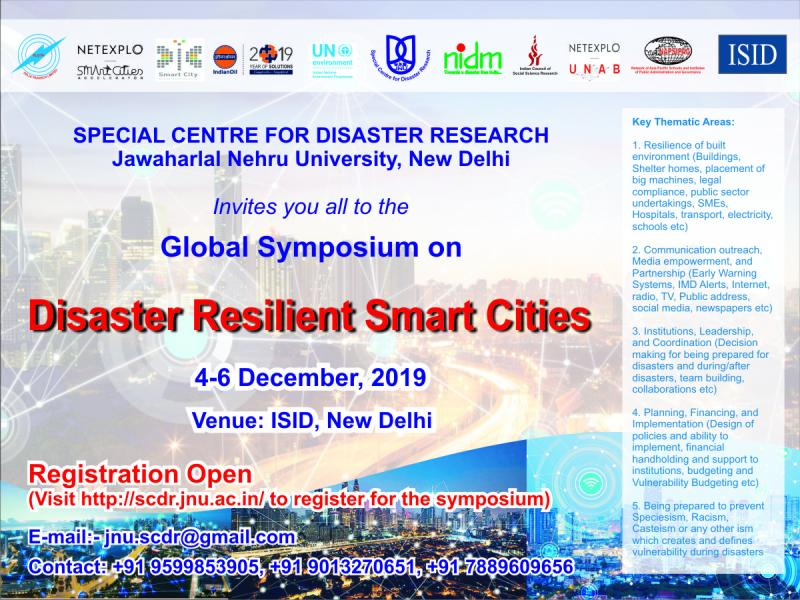
JNU Global Symposium on "Disaster Resilient Smart Cities" | 4-6 December, New Delhi

CSH Workshop on Digital Empire(s): Perspectives from Asia and Africa | 4 December, New Delhi


Workshop on Digital Empire(s): Perspectives from Asia and Africa
Date: Wednesday, 4th December 2019
Venue: CSH Conference Room, New Delhi

Schedule
9.00 : Welcome note by Nicolas Gravel (CSH) & Mathieu Quet (CEPED- IRD)
9.15 to 13.15 : Session 1 on Digital Empire(s)
- On technological empire as an analytical tool (Mathieu Quet, CEPED-IRD).
- Skeletal and elephantine bureaucracies in Africa and India : comparing histories of registration and their effects on digital infrastructures. (Keith Breckenridge, Wiser)
- From Ghana to India, saving the global south's mothers with a digital empire (Marine Al Dahdah, Cems-CNRS).
- Digital and Visual Populism: Personalised Politics and Online Publics in the PostColony (Krishanu Bhargav Neog, CPS-JNU)
- Feedback Loops and (In)Significant Voices: Social Interactions with ID Systems of Digital Empires in South Asia and East Africa- (Rajiv Mishra, CSSP-JNU)
- Netflix, Amazon Video and Jio Cinema : Reflection on the notion of digital empires through the prism of audiovisual platforms (Christine Ithurbide, LabSIC-Paris13)
- Colonializing the nation through digital technology (Ursula Rao, Leipzig University)
14.00 to 18.30 : Session 2 on Digital Empire(s)
- The invention of the electoral biometrics market in Africa (Marielle Debos, Univ. Paris Nanterre)
- Tracing digital governance and the history of ICTD developments in India. (Khetrimayum Monish Singh, CIS).
- Marketizing water in Kenya: From "dependency syndrome" towards a radiant future? (Christiane Tristl, Goethe Universitat)
- Calibrating digital payments in India (Javed Alam, JNU-Univ. of Paris)
- Digital Empire as Biometric Labor Division. Notes for a regressive anthropology of technology from the Senegalese electoral administration (Cecilia Passanti, University of Paris)
- The Rise of the Invisible Publics: Reality TV as Visibility Infrastructures in Northeast India (Sagorika Singha,SAA-JNU)
- Digitalization of social security in Nepal (Sohan Sha, Martin Chautari)
- The digital in communicating peace and conflict in the Sahel (Mirjam de Bruijn, Leiden University)
Registration
RSVP mentioning your full name to: neeru.gohar[@]csh-delhi.com. Due to security protocols, we request you to please pre-register over email and kindly carry an ID proof to be granted access to the venue.

Wednesday, November 6, 2019

CSIR- NISTADS Invited Talk "Measuring andCharacterizing Indian Scientific Research: New Dimensions" by Dr Vivek Singh, BHU | on 11th November

CSIR- NISTADS Invited Talk


A Talk by Dr Vivek Singh, Professor of Computer Science and Director, Computer Centre at Banaras Hindu University, Varanasi.


Title:  Measuring and Characterizing Indian Scientific Research: New Dimensions

Date and Time:   11th November, 2019; 4.00 PM

Venue: NISTADS Conference Hall


Abstract: The talk will attempt to address quantitative pursuits in Indian Science, addressing several traditional issues like India's research output, global share and rank, disciplinary distribution of research output and international collaboration patterns. The main emphasis will be on quantitative methods and how they can be used to draw inferences useful for science policy. The talk will include discussion on issues of gender and research publishing as well as open access levels and patterns in Indian research. The University-Industry-Government collaboration in research would also be looked into. The talk will also discuss on a very important and emerging issue of social media attention of Indian research output, including characterizing the type of research output that gets significant attention in different social media and news platforms.


About the Speaker: Dr Vivek Singh is Professor of Computer Science and Director, Computer Centre at Banaras Hindu University, Varanasi. His primary research interests are in Information Systems, Text Analytics and Scientometrics. He has rich volume of scholarly work. He has worked on several research projects, including those involving international collaboration with Germany, Mexico and Brazil. He is on the review board of many top-tier SCIE indexed journals, including Scientometrics, Information Processing and Management and several IEEE Transactions. He is one of the Editors of The Journal of Scientometric Research, a Life member of ISSI and Computer Society of India and Senior Member of IEEE & ACM.

ALL ARE CORDIALLY INVITED

UNESCO meeting on building water resilient cities in the age of climate change, 7 & 8 November

UNESCO Media Advisory No.2019-47
UNESCO meeting on building water resilient cities in the age of climate change, 7 & 8 November
Paris, 06 November – UNESCO in collaboration with New York University, will host a colloquium at its Headquarters in Paris (7-8 November) to share lessons learned from the havoc climate change is already wreaking on cities around the world: Hurricane Sandy unleashed its fury on New York City in 2012, floods hit Paris in 2017 and Cape Town experienced water shortages earlier this year.
The colloquium will examine innovative solutions and strategies, including funding, needed to handle increasingly frequent extreme hydrological events, develop resilient infrastructures and promote the sustainable preservation of urban ecosystems. Innovative technology solutions to improve resilience will be high on the agenda alongside discussions about the role of public education and the media in building community responses and developing a culture of climate-crisis awareness.
Dubbed the "Metropolitan R2020" E.C.O.-R.I.S.E. (Eco-development & Climate-impacts Offsetting challenges for Resilient Infrastructure & Sustainable Ecosystems), the colloquium aims to create an experience-sharing forum among metropolitan stakeholders, from the private and public sectors, as well as media and academe.
Notable speakers will include: Youssef Filali-Meknassi, Director, UNESCO's Water Science Divison; Eric Mac Farlane, Deputy Commissioner, New York City Department of Design and Construction, Benjamin Gestin, Chief Executive Officer, Eau de Paris, Thierry Witkowicz, Senior Vice President, Business Development Smart Cities, Veolia (the French-based resource management group), Diane d'Arras, President, International Water Association (IWA), Maximilien Pellegrini, CEO, Suez Water (France), Sébastien Maire, Chief Resilience Officer, City of Paris, Fadi Comair, Honorary President, Mediterranean Network of Basin Organisations (MENBO) and CEO, Water Resources Lebanon, Milo Fiasconaro, Executive Director, Aqua Publica Europa, the EU Association of Public Water Operators, Amit Chanan, Director of Infrastructure Projects, City of Sydney (Australia).
The University of Lille (France), the School of Engineering of the City of Paris, W-SMART (International Alliance of Water and Wastewater Utilities for Sustainable Water Security), Greater Paris Sanitation Authority (SIAAP) and the International Water Association's Specialists Group of Water Safety & Security Management (IWA-W2SM) have also contributed to the development of the colloquium.

****

Contact for mandatory press accreditation: Djibril Kébé, UNESCO Press Service, (d.kebe@unesco.org, +33(0)1 45 68 17 41)


UNESCO, 7, place de Fontenoy, PARIS, NA FRANCE France

Friday, November 1, 2019

New Book | India in a Warming World: Integrating Climate Change and Development

India in a Warming World: Integrating Climate Change and Development
Edited by Navroz K. Dubash, Oxford University Press, New Delhi, ISBN: 9780199098392
 

About the Book
As science is increasingly making clear, the problem of climate change poses an existential challenge for humanity. For India, this challenge is compounded by immediate concerns of eradicating poverty and accelerating development, and complicated by its relatively limited role thus far in causing the problem. India in a Warming World explores this complex context for India's engagement with climate change. But, in addition, it argues that India, like other countries, can no longer ignore the problem, because a pathway to development innocent of climate change is no longer available. Bringing together leading researchers, activists, and policymakers, this volume lays out the emergent debate on climate change in India. Collectively, the chapters deepen clarity on why India should engage with climate change and how it can best do so.

Table of Contents
1. An Introduction to India's Evolving Climate Change Debate: From Diplomatic Insulation to Policy Integration | Navroz K. Dubash
SECTION I CLIMATE CHANGE IMPACTS
2. Impact of Climate Change on India | J. Srinivasan
3. Changing Climate and Weather: Evidence from Attribution Science | Krishna AchutaRao and Friederike Otto
4. Impacts of Global Warming in India: Narratives from Below | Nagraj Adve
SECTION II INTERNATIONAL DEBATES AND NEGOTIATIONS
5. Global Warming in an Unequal World: A Case of Environmental Colonialism | Anil Agarwal and Sunita Narain
6. Equity in Long-Term Mitigation | Tejal Kanitkar and T. Jayaraman
7. India's Engagement in Global Climate Negotiations from Rio to Paris | Sandeep Sengupta
8. Present at the Creation: Th e Making of the Framework Convention on Climate Change | Chandrashekhar Dasgupta
9. One Long Day in Copenhagen | Shyam Saran
10. Reaching Agreement in Paris: A Negotiator's Perspective | Ashok Lavasa
11. India in International Climate Negotiations: Chequered Trajectory | D. Raghunandan
12. Understanding the 2015 Paris Agreement | Lavanya Rajamani
13. India and Paris: A Pragmatic Way Forward | Ajay Mathur
14. Making Sense on Its Own Terms: India in the HFC and Aviation Negotiations | Arunabha Ghosh
SECTION III POLITICS
15. Climate Change, Civil Society, and Social Movement in India | Pradip Swarnakar
16. Business Action on Climate Change: A Perspective from the Private Sector | Shankar Venkateswaran and Mukund Rajan
17. Energy and Climate Change: A Just Transition for Indian Labour | Ashim Roy , Benny Kuruvilla , and Ankit Bhardwaj
18. Looking Out, Looking In: Th e Shifting Discourse on Climate Change in the Indian Print Media | Anu Jogesh
SECTION IV POLICY
19. National Climate Policies and Institutions | Navroz K. Dubash and Shibani Ghosh
20. From Margins to Mainstream?: State Climate Change Planning in India | Navroz K. Dubash and Anu Jogesh
21. State Climate Change Planning: Has It Reached the Mainstream? | Elizabeth Gogoi
22. Climate Finance | Koyel Kumar Mandal
23. Managing the Climate Technology Transition | Ambuj Sagar
SECTION V CLIMATE AND DEVELOPMENT
24. Aligning Energy, Development, and Mitigation | Ashok Sreenivas and Ashwin Gambhir
25. Urban India and Climate Change | Radhika Khosla and Ankit Bhardwaj
26. Climate Change and India's Forests | Sharachchandra Lele and Jagdish Krishnaswamy
27. Climate Adaptation in the Water Sector in India | Veena Srinivasan
28. Mainstreaming Climate Change Adaptation: Agriculture | K.S. Kavi Kumar and Brinda Viswanathan
29. Shoring Up: Climate Change and the Indian Coasts and Islands | Rohan Arthur