- Research and Development Statistics at a Glance 2011-12: http://www.nstmis-dst.org/PDF/FINALRnDStatisticsataGlance2011121.pdf
Follow Us: @IndiaSTS | http://twitter.com/IndiaSTS | http://www.facebook.com/csspjnu/ | http://www.mixcloud.com/cssp_jnu/
Friday, October 4, 2013
Just Released -- India's Research and Development Statistics at a Glance 2011-12 & Science & Technology Indicators 2011-12
CfPs: International conference "Technology, accountability and democracy in South Asia and beyond"; 17-18 Jan; Mumbai
International conference "Technology, accountability and democracy in South Asia and beyond"
17-18 January 2014
Venue: University of Mumbai, India
The Stanford University is hosting an conference entitled "Technology, accountability and democracy in South Asia and beyond" on the 17-18 January 2014. Location: University of Mumbai, India. The conference is organised by the Center for South Asia, and the Center on Democracy, Development and the Rule of Law (CDDRL) – both at Stanford University, in partnership with Department of Civics and Politics, University of Mumbai, and the Stanford Alumni Association of India.
Over the last few years, there has been unprecedented focus on corruption and accountability across South Asia. Accountability movements have resulted in a variety of initiatives including special monitoring bodies, transparency laws, monitoring mechanisms, judicial reforms and refining government processes. These initiatives bring different understandings of problems and approaches, with varied strengths and weaknesses. Despite these differences, they are increasingly converging on the use of technology to augment a growing set of accountability strategies. This conference proposes to bring together people who are engaged in these questions as activists, officials, academics and innovators to examine how technology is currently being used for accountability projects and to build meaningful platforms for the future. We specifically seek to bring together people with experience in accountability movements (with or without the use of technology), young innovators and researchers in order to promote rich multidisciplinary conversation and to build new collaborations.
More information and registration.
The Conference invites papers on relevant themes, see the the call for papers.
Tuesday, October 1, 2013
CfPs: Second International Seminar on Philosophy of Education, Azim Premji University, Bangalore, 12-14 May
Azim Premji University, Bangalore, India.
May 12-14, 2014
Call for Papers
Azim Premji University, Bangalore announces its Second International Seminar on Philosophy of Education to be organized from May 12 to May 14, 2014 in Bangalore.
The First International Seminar on Philosophy of Education in January 2013 witnessed the participation of philosophers and scholars of education from across India, Europe, and North America and presentations on a range of philosophical issues in education. The Second International Seminar on Philosophy of Education is proposed to deliberate on the following themes.
Themes of the Seminar
- Social Justice and Education: Social justice has always been an important concern in philosophy of education. In India cultural, ethnic and religious diversity coupled with socio-economic disparities makes it especially relevant at present times when privatisation of education is on an ascending curve. This theme seeks to explore the questions pertaining to the social role of education and equality.
- Indian Philosophical Thoughts/ Thinkers and Education: This theme seeks to establish dialogues between Indian philosophical traditions and modern concerns of philosophy of education. Such an engagement promises to enrich philosophy of education through the infusion of fresh philosophical perspectives. The dialogue could also pertain to Indian thinkers/philosophers (both ancient and modern) and their take on education. Further, the elements of Philosophy of Education could be explored in the traditions of Indian Philosophy.
- Nature of Educational Studies : Curricular and Pedagogic Issues: Many universities in India now are offering Master of Arts in Education or Master of Arts in Educational Studies. These programmes are different from traditional Master of Education (M.Ed.) programmes. The nature and scope of curricula for MA in Education or MA in Educational Studies programmes give rise to many questions that need philosophical considerations For instance, the characterisation of educational studies as a field of liberal study requires resolution before a curriculum with reasonably clear principles of unity can be formulated. This theme is an invitation to explore these and similar questions.
- Policy Issues in Education: Measurement and Assessment, Accountability, Quality in Education: Educational policies in recent times have shown an unprecedented tilt towards nurturing certain kinds of regimes with a claim to ensure better provision and outcomes of education. Some examples are teacher accountability, quality as placement opportunities in higher education and securing admission in college education for school education. Moreover, we are witnessing a refinement of the social purposes of education under the pressure of a globalised economy. Exploration of aims of education in the emerging reform and policy initiatives is itself an important subtheme under the overall theme of policy issues. It is worthwhile to examine the interplay of these issues in education. It is important to examine these concepts from the perspective of what implications they will have on education.
We invite papers on any of the above mentioned themes. Contributions are expected to explore the philosophical significance of the questions emerging within the scope of each theme. However, good quality philosophical papers not falling under any of the above mentioned themes are also welcome.
Papers are invited from philosophers of education, philosophers, educationists, practitioners in education and students of education. Authors are advised to limit their contributions to 4500-6000 words. Papers should be prepared for blind review, and sent along with a 300-words abstract on or before January 1, 2014. The papers may be sent through email to poe.seminar@apu.edu.in.
A top sheet containing the following information must be affixed to each contribution:
(i) Author Name(s)
(ii) Title of the Paper
(iii) Designation and Institutional Affiliation
(iv) E-mail ID.
The document should be saved in the name of the author (first author's name in case of joint authors). Please send the documents either in Windows or Linux Open Office format.
Important Dates
Paper Submission: January 1, 2014
Communication for acceptance of the paper: February 15, 2014
International Seminar: May 12-14, 2014
Publication Policy
Efforts will be made to publish the papers either in internationally noted journal(s) on education as seminar proceedings or as an edited book. The final decision on the issue will be made at the conclusion of the seminar. Authors would therefore be required to submit the final and publishable version of their paper within three months after the conclusion of the Seminar. In view of this policy, authors will be required to provide written consent to submitting the final papers within three months of the conclusion of the seminar, and to allowing publication of their papers either as proceedings in journal(s) or as an edited book.
Travel Policy
It may also be noted that the expenses related to travel and accommodation during the Seminar will be borne by the Azim Premji University. This facility will only be available to those whose papers are accepted for presentation.
Further Details: http://azimpremjiuniversity.edu.in/PoE
Friday, September 27, 2013
JGU Workshop on Ethics in Gender Based Violence, Child Maltreatment and Public Health, 28-30 Nov, OP Jindal Global University, Sonipat
28-30 November 2013
Venue: OP Jindal Global University, Sonipat 131001, Haryana, India
Organized by Jindal Global Law School, Haryana and Centre for Ethics, Yenepoya University, Mangalore, India
Workshop Coordinators:
Dr Keerty Nakray (Jindal Global Law School) and
Dr Vina Vaswani, Centre for Ethics, Yenepoya University, Mangalore
Resource Persons:
Dr Amar Jesani (Centre for Health and Allied Themes)
Dr Arnab Acharya (Jindal School for Public Policy) and
Professor Richard Cash (Harvard School for Public Health)
Background of the Workshop:
Gender Based Violence (GBV) is a universal phenomenon with variations in the forms of violence perpetrated against women and children across the world. These forms of violence are rooted in the patriarchal nature of society and range from sexual assaults in war situations, within families or places of work, sex selective abortions, acid attacks and mutilation or human trafficking. The last two decades, especially in the developing economies, has witnessed a greater impetus on a public health approach to GBV. This approach focuses on multi-sectoral interventions involving health, social work and care, legal and teaching professionals. Most importantly, research and evidence collection through qualitative and quantitative methods forms the basis of advocacy efforts for directing policy and government's budgets. Gender based violence and child abuse remain difficult areas of research owing to reasons such as (1) Fear of breach of confidentiality (2) Concerns about re-victimisation (3) Possibility of vicarious trauma (4) Difficulties in accessing participants and issues around privacy (5) Availability of psychological, therapeutic and other support services for research participants and researchers. Research on gender based violence and child abuse represents the touchstone of feminist ethics to engage closely with social reality and to change the oppressive gender relations. This workshop will highlight the key ethical issues in researching gender based violence and child abuse. This workshop is targeted towards academics and professionals based in non-governmental or governmental organisations undertaking primary research in the field of gender based violence and child maltreatment.
Aims & Objectives of the Workshop
- To provide an overview of recent debates in social science and public health research globally.
- To introduce guidelines to ethical principles and work whilst conceptualizing research on gender based violence and child maltreatment, through films and case-studies.
- To encourage and generate awareness of various ethical issues that should be addressed while planning, conducting and dispersing on gender based violence and child maltreatment.
- To address issues of physical and emotional safety for research participants and researchers.
- To study the quantitative and qualitative approaches to gender based violence and child abuse.
- To create a supportive environment for researchers to discuss and share their experiences of undertaking research on gender based violence and child maltreatment.
- To promote evidence based research and publications on ethics in gender based violence and child abuse research.
- To understand the practical approaches in specific contexts.
- To study the method of protocol writing, planning and budgeting for studies on violence.
Registration Fees: INR 4500 (Academic Staff) and INR 3000 for PhD/ M Phil students for registration before October 15 2013 and late registration will be accepted till 1st November 2013 and a late fee of INR 1000 will be charged.
Expressions of interest should be sent to: Dr Keerty Nakray, Email: knakray@jgu.edu.in by 15th October 2013 along with a Demand Draft to be made in favour of OP JINDAL GLOBAL UNIVERSITY Sonipat/ By Online transfer in below mentioned account
Wire Transfer Information:
Name of the Account: O P Jindal Global University
Name of the Bank: HDFC Bank Limited
Address of the Bank: L -203, Model Town, Sonipat – 131001, Haryana
Bank Account Number: 01910310000100
IFSC Code: HDFC0000191
Wednesday, September 25, 2013
Call for Participation: 3rd Bangalore Cognition Workshop: Where Minds meet the Brain; IISc, Dec 8-21
December 8-21, 2013
Indian Institute of Science, Bangalore
WHO CAN APPLY:
Candidates in their final year of their Bachelor's degree, pursuing a Masters or PhD. degree in any branch of Science, Engineering or Medicine are welcome to apply. We also welcome postdoctoral fellows, clinicians, and faculty from colleges/universities. Candidates must provide their academic details and submit a statement of interest in the form below. Selected participants will be provided with train fare (3rd AC), boarding and lodging.
Important Dates
October 1 : Application Deadline
October 15: Final participants list
SPONSORS
Indo-US Science and Technology Forum (IUSSTF)
Wellcome Trust-DBT India Alliance
Department of Science and Technology
DST-IRHPA & IISc Mathematics Initiative
Indian Institute of Science
Workshop WEBSITE http://sites.google.com/site/bangalorecognition
Apply online: https://sites.google.com/site/bangalorecognition/apply
Monday, September 23, 2013
The Hindu article "JNU library strives for excellence"
JNU library strives for excellence
Vijetha S.NThe Hindu, NEW DELHI, September 23, 2013
Libraries are at the heart of any institute of learning. A good university must have a good library, otherwise it does not serve its purpose.
Many students are disappointed every year when they do not make the cut to the mostly post-graduate, research-oriented Jawaharlal Nehru University. Since a seat at this university is as difficult to come by as some global universities that are famed for their libraries, the nine-storied JNU library too is trying to fulfil the expectations from it.
"We have six lakh printed books and one lakh e-books available for circulation. We subscribe to 800 print journals annually from all major international and some Indian publications. We also have access to around 2,300 newspapers from 97 countries in 52 languages, and around 55 research databases. Currently, we also have 8 lakh digital newspaper clippings which are relevant to 72 subjects, and possess a rare collection of Urdu, Persian and Art books," said JNU's head librarian Ramesh Gaur, who was called in around two years ago to overhaul the library which had been leaderless for almost five years.
"The most recent activity we carried out was to digitise around 20,000 thesis and dissertations, the hard copies of which were lying around. Those that are more than three years old can be accessed from anywhere in the world, whereas the others will be available on the net anywhere on the campus," he said, adding that when he got there, the first thing he noticed was the mess in the mezzanine section on the ninth floor.
The "before" pictures of this area show dusty books stacked high and almost reaching the ceiling, while "after" pictures show students sitting on wooden benches calmly reading or writing. "The room was hardly used, serving as a warehouse of sorts which was a pity since the view was so nice," he said. There are lifts, so it is easy to make use of the stunning view of the entire campus as well as the neighbourhood.
"The library has a carpet area of one lakh square feet and a seating capacity of 1,000. It opens at 8 a.m. and remains open until midnight. There is also a 24/7 reading room, which can seat more than a hundred on the ground floor. We have around 200 computers and a special section called "Helen Keller" meant for visually-challenged students with the latest assisted technology. Locker facilities are given to Ph.D. students and another new addition is more plug points for students to charge their computers. All our material has been catalogued," Dr. Gaur said.
Libraries have to evolve so there is a stock verification done routinely. The library, in a bid to be more involved, has also started the "JNU forum for mutual learning" where it organises guest lectures and author workshops. "Students want these workshops; we have editors coming and telling them how to get their work published, how to write abstracts, proposal letters and everything. We also organise book releases and other talk programmes and conferences," he said.
The latest facility the library has procured is the "turn it in" software that checks plagiarism. The university has made it compulsory for students to run their thesis through this software that points out any similarities that might exist with the work submitted and any other publication. "The Ph.D. supervisor also puts the thesis through this software, even after the student has submitted the report."
The library went one step further this past year when it set up a stall at the World Book Fair in the city showcasing student and faculty publications. "That was a first," added Dr. Gaur.
Thursday, September 19, 2013
Participate in a Science Slam on 17 Nov 2013 in Ahmedabad, organized by DWIH Indiafor students/ post-docs from any field of Science/Humanities/Social Sciences
15 November, 2013 - 22 November, 2013
Organized By German House for Research & Innovation (Deutsches Wissenschafts- und Innovations Haus, DWIH), New Delhi
Call for Applications for students/ post-docs from any field of Science/Humanities/Social Sciences
Deadline for Applications: Monday , 7 October 2013
What is a science slam? It ́s an unconventional way to bring together passionate researchers and the curious public. Bring science on stage! Compete for the hearts of the audience by your performance in a maximum of ten minutes.
What do you need? Excellent knowledge of your research subject, your courage & presentation skills.
How should a Slam look like? You are the best judge! Be creative! Be funny! Any format is allowed, from the conventional talk to a stage play or musical performance. Just respect the time limit of ten minutes.
How do you benefit? Apart from exposure to other fields of science and a new experience, the winner will have a chance to spend two months with an eminent research group in Germany.
Send your applications along with a photograph to: info@dwih.in
(Please write "Application for the Science Slam" and your name in the subject line)
For ideas, please see the link:
http://www.youtube.com/watch?feature=player_embedded&v=qtgnaiLR-WA#!
Eligibility
- Students, registered for M.A., M.Sc., M.Phil. or Ph.D. with a recognized Indian University/Institutes, or
- Post-docs (up to 6 years of completion of Ph.D.)
Subjects
- Medicine/ Physiology
- "Green" Life Sciences
- Physics/ Mathematics/ Geo Sciences
- Chemistry & Process Engineering
- Engineering/ Informatics
- Humanities & Social Sciences
http://www.dwih.in/content/dwih-new-delhi-excellence-tour-ahmedabad
Wednesday, September 18, 2013
CSRD Workshop on Using Life Cycle Assessment and a Systems Approach to Sustainability, 27 Sept-1 Oct.
Centre for the Study of Regional Development, JNU
Workshop on
Using Life Cycle Assessment and a Systems Approach to Sustainability
The Centre for the Study of Regional Development, JNU in collaboration with Oxford University, UK is organsing a learning workshop on 'Using Life Cycle Assessment and a Systems Approach to Sustainability' during 27 September-1 October, 2013. This workshop will provide an understanding of the concepts, merits and pitfalls of Life Cycle Assessment (LCA), and how LCA can be combined with techniques from different disciplines to understand interactions within and between different measures of sustainability. The workshop would be conducted by Dr. Alfred Gathorne-Hardy from Oxford University. Interested candidates are requested to apply with a short CV and brief note on the relevance of the workshop for their current/ future research to Dr Deepak K Mishra, CSRD, JNU (E-mail: deepakmishra@jnu.ac.in ; deepakmishra.jnu@gmail.com) on or before 20th September 2013.
CSRD Workshop on Using Life Cycle Assessment and a Systems Approach to Sustainability, 27 Sept-1 Oct.
Centre for the Study of Regional Development, JNU
Workshop on
Using Life Cycle Assessment and a Systems Approach to Sustainability
The Centre for the Study of Regional Development, JNU in collaboration with Oxford University, UK is organsing a learning workshop on 'Using Life Cycle Assessment and a Systems Approach to Sustainability' during 27 September-1 October, 2013. This workshop will provide an understanding of the concepts, merits and pitfalls of Life Cycle Assessment (LCA), and how LCA can be combined with techniques from different disciplines to understand interactions within and between different measures of sustainability. The workshop would be conducted by Dr. Alfred Gathorne-Hardy from Oxford University. Interested candidates are requested to apply with a short CV and brief note on the relevance of the workshop for their current/ future research to Dr Deepak K Mishra, CSRD, JNU (E-mail: deepakmishra@jnu.ac.in ; deepakmishra.jnu@gmail.com) on or before 20th September 2013.
Tuesday, September 17, 2013
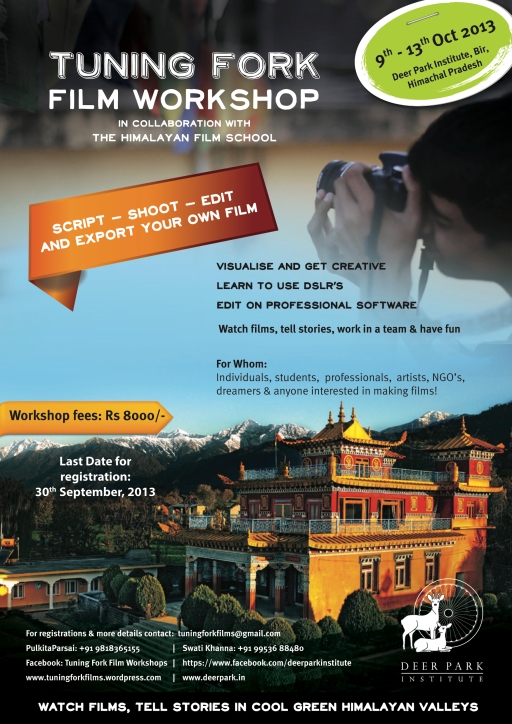
CfP: Tuning Fork Film Workshop, at at Deer Park Institute, Bir, Himachal Pradesh; 9-13 October
TUNING FORK FILM WORKSHOP
at Deer Park Institute, Bir, Himachal Pradesh
9th-13th October 2013
Watch Films, Tell Stories, Learn to Script – Shoot & Edit

Tuning Fork Film workshops are about:
- Learning to make films
- Visualising & getting creative
- Learning to shoot & edit
- Working in a team
From an idea to a film, make your OWN FILM in 5 days!!
It is a process that involves creativity, skill building & teamwork
Workshop Module – Aspects Covered
'READING' FILMS
- Breakdown the film into different components – understand the language of cinema
- Understand its nuances – how the medium of film works
- watch and discuss different kinds of cinema – world cinema, documentary, and short films
MAKING FILMS
- Using a DSLR & video Camera, basics of photography & visual aesthetics
- how to visualize and transform an idea into a story
- Process of film making – Scripting, Storyboarding, Shooting & Editing
- Learn to edit: Digital Video Editing & Video Technology (Final Cut Pro & Adobe Premiere Pro)
- Practicalities of finances & budgets on making films
- making a film: from START to FINISH
For whom: This workshop is for anyone with an interest in films. Individuals, students, professional, NGO's, artists, media professionals and whosoever keen on making films with just a camera and a laptop!
Workshop Costs:
Rs. 8000 (includes workshop costs & boarding & lodging at Deer Park Institute)
How to register: Fill in the attached form and send it to us with a registration fee of Rs. 1000 (deductible from total workshop fee)
LAST DATE FOR REGISTRATION: 30th September 2013
Monday, September 16, 2013
Call for Applications -- Chevening Rolls-Royce Science and Innovation Leadership Programme
Chevening Rolls-Royce Science and Innovation Leadership Programme
BRINGING TOGETHER THE BEST OF INDIA AND THE UK
The Chevening CRISP Programme is open from 13 September 2013 to 1 November 2013.
The CHEVENING ROLLS-ROYCE SCIENCE AND INNOVATION LEADERSHIP PROGRAMME is a Scholarship funded by the Foreign and Commonwealth Office and Rolls-Royce for 12 mid-career top level people in the field of science and innovation - with links to public policy - in India. It will provide funding for three months' study on a tailor-made course in the UK.
The Chevening Rolls-Royce Science and Innovation Leadership Programme (CRISP) is a unique programme aimed specifically at mid-career Indian professionals working in the fields of science, innovation, business and related public administration. The ideal candidate should be in mid-career in business or the public sector with exceptionally high potential. The following disciplines are particularly relevant: business, research, technology, manufacturing, and public administration.
This programme provides an invaluable opportunity for Indian professionals to establish their own networks of contacts in the UK who would be of direct value to their work and career development in India.
Applicants SHOULD NOT apply directly to the UK programme providers. Simply complete the Chevening application.
Each Scholarship covers the following:
- Full Programme fees
- Living expenses for the duration of the Scholarship for a maximum period of 11 weeks
- Return airfare from India to UK
- UK Student Visa
Science and Innovation Leadership Programme
The Programme offers an intense all-expenses paid 11-week course at the prestigious Saïd Business School at the University of Oxford.
Its wide range of modules will include lectures, workshops, visits and interactions with high profile companies and scientists, and will bridge pure research and business/scientific entrepreneurship, practical processes of innovation, commercialisation of research and technology transfer.
The course is aimed at some of India's brightest scientists, business people and public servants.
Aims of the programme
The objectives of the Programme are to:
- promote the role of science and innovation as a driver of growth and opportunity
- forge lasting ties between the UK and India's future leaders
Participants will
- develop an understanding of the UK science base and a range of innovation management processes
- explore the interactions between research, innovation and policy
- research and present a business plan based on their own interests and experience
- visit a wide range of UK institutions, research institutes, businesses and social entrepreneurship organisations
- take part in a varied cultural programme, and explore potential insights from the arts to the working environment
The programme provides opportunities for personal and professional development and for participants to extend their own individual UK-India network.
Programme content
The programme includes a mixture of academic sessions, visits, group and individual projects, tutorials/ mentoring sessions (including personal development), debates, guided/focused study visits and seminars and projects of professional relevance, and social and cultural activities (with an emphasis on visual and spoken communication). There will be significant contact with UK specialists and opportunities for participants to develop their own connections and interests.
There will be four main strands: Science, Innovation, Leadership & Management and Politics/Policy. Each module will include lectures, exercises and discussions that focus on relevant ideas and challenges. As part of the programme each participant will research, develop and present a business plan.
Throughout the programme, participants will receive personal and profession development coaching from trained mentors at the Said Business School. These mentors will help guide individuals and groups through the content of the programme, and will also work to ensure that each person gets the most out of his or her experience.
Participants will be asked to keep a video-diary of their time at Oxford, either individually or in groups. Training on how to do this well will occur in week one, so that the diaries can be a useful learning tool as well as a fond record of an extraordinary experience and a creative output to share with others.
There will be three main modules: science, innovation and policy.
Each module will include lectures, workshops and discussions that focus on relevant ideas and institutions, and introduce the group to experts and opinion leaders, together with a significant element of practice, including case studies, visits and projects.
A programme of external speakers, visits, projects and events will ensure a lively variety of engagement with UK institutions throughout.
The Saïd Business School:
The Saïd Business School is one of Europe's youngest and most entrepreneurial business schools. An integral part of the University of Oxford, the School embodies the academic rigour and forward thinking that has made Oxford a world leader in education. The School is dedicated to developing a new generation of business leaders and entrepreneurs, and conducting research not only into the nature of business, but the connections between business and the wider world.
For university details please visit http://www.ox.ac.uk/ and http://www.sbs.ox.ac.uk/Pages/default.aspx
Partner organisation
The award is supported by one of the UK's most innovative companies, Rolls Royce.
Rolls-Royce is actively involved in, and supportive of, educational opportunities and activities for students, graduates and professional executives. The company is a world-leading provider of power systems and services for use on land, at sea and in the air, and has established a strong position in global markets - civil aerospace, defence aerospace, marine and energy. In 2009, Rolls-Royce invested £864 million in research and development, two thirds of which had the objective of further improving the environmental aspects of its products, in particular the reduction of emissions. Please visit the Rolls-Royce website for more detail: http://www.rolls-royce.com/
Eligibility criteria
Successful applicants should have the 'Chevening' qualities of ambition, drive, and leadership potential, a commitment to change and organisational development, a talent for innovation and creativity, and the ability to adapt to rapidly changing circumstances, not only in technical and professional terms but also culturally.
How to apply
Applications for the Chevening Rolls-Royce Science and Innovation Leadership Programme are open until 1 November 2013.
Before applying, applicants should read the Appendix on short courses in the Guidance.
Applicants must complete an online application form and submit their application before the deadline.
Thursday, September 12, 2013
Call for Participation: e-Learning Course on Export Promotion and Market Access for Agriculture and Food Products from Asia [13-AG-07-GE-TRC-B]; 17-19 September, hosted by National Productivity Council, Delhi
e-Learning Course on Export Promotion and Market Access for Agriculture and Food Products from Asia [13-AG-07-GE-TRC-B]
(based on the Global Development Learning Network of the World Bank platform)
17-19 September 2013
Organized by National Productivity Council, New Delhi
Further Details: http://www.apo-tokyo.org/wp/annual-program/files/2013/01/e-Learning-13-AG-07-GE-WSP-B-Export-Promotion-PN-PNA1-PNA21.pdf
Nomination Form is Attached here.
Please send your Nomination Form to Bajrang Lal <bajrang.lal@npcindia.gov.in> latest by 13 September 2013
---------- Forwarded message ----------
From: Bajrang Lal <bajrang.lal@npcindia.gov.in>
Dear Sir,
Kindly find Attached programme details for above mention e-learning programme. The participation fee has been waived off for few participants.
Kindly, confirm at the earliest so that we can accommodate you without fee.
With Best Regards
.................................................................................................. Bajrang Lal
Assistant Director,
National Productivity Council M/o Comm & Industry
Utpadakta Bhavan, 5-6 Institutional Area, Lodhi Road,
New Delhi - 110003
Website -http://www.npcindia.nic.in
Email: bajrang.lal@npcindia.gov.in
Phone +91-11-24607375
EPBX-+91-11-24690331 Ext-375
Fax- +91-11-24615002
EPABX Lines : 24690375,
Gram : PRODUCTIVITY, Fax : 91-11-24615002, 8447469855
...............................................................................................
Wednesday, September 11, 2013
CfAs: 2013 Emerald/EFMD Outstanding Doctoral Research Awards: International recognition and cash awards for the best doctoral research
2013 Emerald/EFMD Outstanding Doctoral Research Awards: International recognition and cash awards for the best doctoral research
Key dates: The closing date for applications is 1 October 2013.
Apply now!
Emerald Group Publishing Limited, publisher of the largest collection of international business and management journals, and the European Foundation for Management Development (EFMD), a global membership organization with more than 700 institutional members from academia, business and public services, seek to celebrate excellence in research by sponsoring the 2013 Emerald/EFMD Outstanding Doctoral Research Awards.
Award-winning entries will receive a cash prize of €1,500 (or currency equivalent), a certificate and a winners' logo to attach to correspondence. In addition, a number of Highly Commended Awards will be bestowed. This year there are 12 categories:
Submission requirements
1. Researchers must apply online using the application form at:
http://ww2.emeraldinsight.com/awards/odra.htm
2. The following documents will be required electronically:
• Covering letter – as part of this please state whether or not your doctoral research has been published and/or will be published in any form (conference paper, article, peer reviewed journal, etc)
• Executive Summary – paper that summarises the Doctoral research. The Executive Summary should not exceed 2,000 words (reference lists and presentation of data, as either Tables or Figures, do not count towards this total). Please download the template executive summary.
• Letter of recommendation/reference from a supervisor/senior faculty member. The letter should state why your supervisor feels that your work is outstanding and what impact it will have. For short-listed applicants, further contact may be made with the referee.
3. Applicants must only submit to one of the categories below.
Awards by category
- Educational leadership and strategy
- Hospitality management
- Human resource management
- Information science
- Interdisciplinary accounting research
- Knowledge management
- Leadership and organization development
- Logistics and supply chain management
- Management and governance
- Marketing research
- Operations and production management
- Healthcare Management
Interdisciplinary accounting research: Category sponsored by Accounting, Auditing & Accountability Journal
Marketing research: Category sponsored by European Journal of Marketing
Hospitality management: Category sponsored by International Journal of Contemporary Hospitality Management
Operations and production management: Category sponsored by International Journal of Operations & Production Management
Logistics and supply chain management: Category sponsored by International Journal of Physical Distribution & Logistics Management
Information science: Category sponsored by Journal of Documentation
Educational leadership and strategy: Category sponsored by Journal of Educational Administration
Knowledge management: Category sponsored by Journal of Knowledge Management
Management and governance: Category sponsored by Management Decision
Human resource management: Category sponsored by Personnel Review
Leadership and organization development: Category sponsored by Leadership & Organization Development Journal
Health Care Management: Category sponsored by Journal of Health Organisation and Management
If you are unsure of which category to submit to please feel free to contact us, and after consultation with our Editorial team, we can suggest that which is most appropriate.
Eligibility
To be eligible for the Awards, the research must address an issue that is of importance to one of the various subject areas listed above. The Awards are open to those who have completed and satisfied examination requirements for a Doctoral award, between 1 October 2010 and 1 October 2013, and have not applied previously for one of these Awards.
Judging criteria
The entries will be judged by the Editor(s) and at least one Editorial Advisory Board member of the sponsoring journal. Entries will be judged on the following criteria:
1. Significance/implications for theory and practice.
2. Originality and innovation.
3. Appropriateness and application of the methodology.
4. Quality of data/research.
Short-listed applicants may be required to answer further questions as appropriate from the judging panel. Winners will be required to submit an unpublished paper, sole- or joint-authored, derived from the research, within six months of winning the Award. The Editors reserve the right not to select a winning paper if, in their judgment, none of the entries is considered satisfactory.
Please note that the decision of the judges is final. Due to the large number of submissions, applicants will not receive any feedback.
For further information
Please read the frequently asked questions.
For any additional information please contact: http://www.emeraldinsight.com/research/awards/odra.htm
Monday, September 9, 2013
CSRD Workshop on Using Life Cycle Assessment and Systems Approach to Sustainability; 27 September-1 October; at JNU
UGC-CAS Programme
Centre for the Study of Regional Development, JNU
in collaboration with Oxford University, UK
A Learning Workshop on Using Life Cycle Assessment and Systems Approach to Sustainability
27 September – 1 October 2013
Organized by Centre for the Study of Regional Development, JNU
This Workshop will provide an understanding of the concepts, merits and pitfalls of Life Cycle Assessment (LCA), and how LCA can be combined with techniques from different disciplines to understand interactions within and between different measures of Sustainability.
Eligibility: Workshop is open for PhD scholars, postdocs, faculty and researchers working in any university, institute and independent researchers working on related areas. Priority will be given to candidates who are likely to use Life Cycle Assessment in their on-going, future research.
Application: Interested candidates may apply with their one page CV and a one page write-up on the relevance of the workshop for their current/ future research to the organizers at deepakmishra@jnu.ac.in on or before 20 September 2013.
Resource Persons: Dr. Alfred Gathorne-Hardy, Oxford University, UK; Dr. Deepa K Mishra, CSRD, JNU
Friday, August 30, 2013
CfPs: 55th Annual Conference of Indian Society of Labour Economics (ISLE); 16-18 December; at JNU, New Delhi
16-18 December, 2013
Jawaharlal Nehru University, New Delhi
55th ISLE Annual Conference:
The 55th Annual Conference of the Indian Society of Labour Economics (ISLE) will be held during 16-18 December 2013 at Jawaharlal Nehru University (JNU), New Delhi. Professor Jayati Ghosh, Chairperson, Centre for Economic Studies and Planning (CESP), School of Social Sciences (SSS), JNU is the Conference President. Professor Praveen Jha, CESP and Chairperson of the Centre for Informal Sector and Labour Studies (CISLS), SSS, JNU is the Local Organising Secretary.
The themes for the 55th ISLE Conference:
- SOCIAL INCLUSION AND THE LABOUR MARKET
- CHANGING PATTERNS OF RURAL LABOUR IN INDIA
- LABOUR REGULATION IN INDIAN INDUSTRY
DATES TO REMEMBER
- Dates of the Conference: 16-18 December 2013
- Last Date for Submission of Papers: 31 October 2013
- Communication from ISLE about acceptance of Papers: 15 November 2013. Those who want an early communication on the acceptance of their papers should request for early information in this regard while sending their papers.
- Last date of registration: 30 November 2013
Registration fee may be made in favour of "2013 ISLE ANNUAL CONFERENCE", payable at State Bank of India, JNU New Campus Delhi, 110067 and sent by 30 November 2013 to the local organizing secretary Professor Praveen Jha, Chairperson, Centre for Informal Sector Informal Sector and Labour Studies, School of Social Science, JNU, New Delhi- 110 067 with soft copy to 55isleconference.jnu@gmail.com
REGISTRATION FEE: The registration fee for the Conference is Rs. 1000/-. Registration will entitle the participants to avail of modest boarding and lodging as well as the conference kit. The completed registration form along with a demand draft (DD) drawn in favour of 2013 ISLE Annual Conference, payable at State Bank of India, JNU New Campus Branch, New Delhi, should be sent to the organizers at the address mentioned below by 30 November 2013.
Participants who have not renewed their membership of the ISLE for the year 2013 need to pay their membership fee to be able to attend the Conference. The annual membership fee is Rs. 400/- for those from India (Rs 4000 lifetime), and US $75 for those from developing countries, and US $125 for those from other countries.
On spot registrations commence on 15 December 2013 at JNU at 1 pm. Delegates are requested to send complete information along with the registration fee at the earliest so that proper arrangements can be made for their accommodation. Online/prior registration is advised. Kindly note, for those who register on the spot, it may be difficult for us to arrange for accommodation.
TIMINGS OF THE CONFERENCE
The Conference will start at 9:30 am on 16 December 2013 and will be over by Lunch on 18 December, 2013. The delegates are advised to reach a day prior to the Conference and depart in the evening of 18 December 2013.
PRE CONFERENCE EVENT: A pre-conference event is also being planned in the afternoon of 15 December, 2013 (1.30 pm - 7 pm) and those who want to participate in it should reach New Delhi by noon on 15 December, 2013.
For an update on the conference, please visit the ISLE website: http://www.isleijle.org, http://www.ihdindia.org or call at + 91 - 11- 23358166/ 23321610; Fax: +91-11-23765410, or email at conference.isle@gmail.com
Facebook Page: Indian Society of Labour Economics - Isle
More Information:
About Conference and other information
Draft Progarmme Structure
ISLE Membership Form
ISLE Registration Form
HTML5 Tours in India (in 5 metropolis cities - New Delhi, Bangalore, Hyderabad, Kolkata and Pune); 17-25 September
17-25 September 2013
Organized by World Wide Web Consortium (W3C) India Office
HTML5 is the cornerstone of the Open Web Platform that the Web community is building. The Web has become a critical global resource that is transforming all industries, including mobile, television, gaming, publishing, and health care. Forward-thinking industries are turning to the Web as the platform of choice for integrating diverse devices, services, and business models. This W3C HTML5 training course will let you know about all the new features that were introduced to help Web site authors to create great Web sites, in a simplified but powerful way. The World Wide Web Consortium (W3C) India Office is organizing an HTML5 Tour in India from 17 - 25 September 2013. The Eminent technology leader & expert from the World Wide Web Consortium will impart training on HTML5 and W3C's Open Web Platform to developers, students and other academies. The Tour will be scheduled across India's 5 metropolis cities - New Delhi, Bangalore, Hyderabad, Kolkata and Pune.
1. 17th September 2013
Location : New Delhi
Theme : Authoring the Web: New ways to build complex Web content, including the use of Web Components
2. 19th September 2013
Location : Bangalore
Theme : Understanding the Web: Core features of the Web Platform (aka HTML5)
3. 21st September 2013
Location : IIIT Hyderabad
Theme : Powering the Web: New ways to tune and optimize the performance of Web applications
4. 23rd September 2013
Location : C-DAC Kolkata
Theme : Rethinking the Web: New modes of operation for Web applications,including offline Web applications, the Next Generation
5. 25th September 2013
Location : C-DAC, Pune
Theme : Connecting the Web: New ways to use the Web to connect with other people, including real-time video chat and video conferencing (WebRTC)
Essential Knowledge:
HTML: Basic Knowledge of HTML
CSS: minimal familiarity with CSS
DOM: extensive knowledge of the DOM is not necessary, but the ability to work with some of its more basic methods (getElementById, appendChild, etc.) is required
JavaScript: basic knowledge is sufficient
Who should attend?
Web developers and content authors ready to update their skills with HTML5
Web designers
Mobile Web developers
Beginning to intermediate programmers with basic Web knowledge who want to learn new skills
Online Registration: http://w3cindia.in/registration.aspx
Note:- Participation will be confirmed through an Email.
Tuesday, August 27, 2013
National Student Challenge 2013: come up with creative ideas to solve some of the most pressing urban problems
National Student Challenge 2013
The Indian Institute for Human Settlements (IIHS) announces the National Student Challenge (NSC) 2013.
NSC 2013 brings together young people who want to be change-makers in India's urban transformation. If you believe that you can design solutions to some of the most pressing urban problems – mobility, housing, livelihoods, education, safety and violence, and disaster risk reduction – NSC 2013 is the platform for you.
We invite undergraduate, postgraduate and doctoral students from institutions all over the country to come up with creative ideas to solve traffic problems, manage waste or provide viable livelihood options to the urban poor. Winning teams will receive an implementation grant from the Rockefeller Foundation, in addition to expert guidance and support to turn their ideas into sustainable ventures.
Eligibility Criteria
Undergraduate Students
Post-graduate Students
Doctoral Students
Age Limit: 30 Years (As of 15.10.2013)
Participate in the 'Challenge'
1. Form teams of 3 to 5 students
2. Identify an urban challenge
3. Formulate Problem Statement and a Possible Solution Statement
4. Submit Problem and Solution Statements
After submission
The deadline for submission of statements is 01.10.2013. 25 teams will be shortlisted based on several parameters and notified by 13.10.2013. If your team is shortlisted, you will be assigned a mentor, a subject matter expert in your chosen theme, who will help streamline your solution. After 6 weeks of mentoring, you will present your solution to an eminent jury at the finals on December 11 and 12, 2013 at the IIHS Bangalore Campus.
"Cultural Expression" to an Urban Issue
The 25 shortlisted teams have the option of expressing their observations about Urban Issues through creative arts. You may also select a performing art to portray your idea. The expressions could be in the form of play-acting, film, dance & song, role-play, narration, miming, parody, photography or painting. These expressions could complement your chosen themes and provide relatable context. Cultural Expression is optional.
Prizes
Top three teams will receive an implementation grant of Rs. 3,00,000 from the Rockefeller Foundation apart from the individual cash prizes they also get.
Additionally, please free to contact us at any point of time at nsc@transformurbanindia.com or call us at: 91-80-67606666. You can ask for either Shalini Pal or Sarat Chandra Gnanamgari and we'll be happy to assist you with your queries. We wish you all the best!
IMPORTANT DEADLINES
09|09|2013 – Final date for registration of teams
01|10|2013 – Final date for the submission of the statements
12|10|2013 – Final shortlisting of the teams
19|10|2013 – Mentor mapping and assigning of mentors
11 & 12 December 2013 – NSC 2013 Finals
School of Environmental Sciences
Jawaharlal Nehru University
Cordially invites you to a presentation on
NATIONAL STUDENT CHALLENGE 2013
Speakers: Team, Transform Urban India, Indian Institute for Human Settlements (IIHS), Bangalore
Date: 3rd September (Tuesday)
Time: 3pm onwards
Venue: Seminar Room, SES.
Brief Sketch of the organization: The Indian Institute for Human Settlements (IIHS) is a national education institution committed to the equitable, sustainable and efficient transformation of Indian settlements. IIHS holds its flagship student-focused initiative, Transform Urban India National Student Challenge (TUI-NSC) each year. The NSC 2013 is a platform which aims to bring together young people who want to be change-makers in India's urban transformation. Undergraduate, postgraduate and doctoral students are invited from institutions all over the country to come up with creative ideas to solve problems facing urban centers.
The themes for 2013 include
- Transportation, Mobility - sustainable urban transport, Traffic congestion, Transportation & Environmental Management, New Construction Methods, Green Logistics
- Basic Services – water, sanitation, solid waste management, lack of social community network, public-private partnership
- Livelihoods - securing basic necessities – water, food, shelter, occupational vulnerability, skill up gradation, informal employment
- Human Development - health, education, employability
- Housing - housing stock at different income levels, possibilities & limitations of private players
- Urban Culture - social practices associated with modern cities, way of life
- Safety & Violence - safety at workplace, in schools, on road, in hospitals& treatment, in drugs
- Urban Poor - change in socioeconomic, political, bureaucratic, religious system, reason for urban poverty
- Governance & Institution - act of governing, decisions that defines expectations of people, consensus oriented, accountable, transparent, equitable & inclusive, right to elect
- Disaster risk reduction - man-made situations contribute to disasters, insensitive administration
The winning teams will receive an implementation grant from the Rockefeller Foundation, in addition to expert guidance and support to turn their ideas into sustainable ventures.
• Copy of the brochure available with the AO in SES office
Saturday, August 17, 2013
IIAS Winter School on Life and Thought of Gandhi; at IIAS, Shimla; 20 Nov-4 Dec.
20 November-4 December 2013
Organized by Indian Institute of Advanced Study (IIAS), Shimla
Over the last three decades the scholastic, intellectual, political and social interests in Gandhiji's life and thought has acquired a new urgency and depth. Gandhiji's writings like An Autobiography Or The Story of My Experiments with Truth and Hind Swaraj have been subject of minute textual, philosophical and literary studies. The theory and practice of Satyagraha, constructive work and the institutions that Gandhiji established have come to be studied by historians, political theorists and commentators and chroniclers of social movements. Lives of Gandhiji's associates and interlocutors like Mahadev Desai, J C Kumarrapa, Mirabehn, C F Andrews and Lanza Del Vasto have added to our understanding of Gandhiji. As a result of these studies our understanding of Gandhiana has emerged deeper, richer and nuanced.
The Winter School seeks to acquaint the participant to this variegated intellectual tradition of thinking of and about Gandhiji. The School would seek to provide a non-fragmentary understanding of Gandhiji's life and thought. Quite often we have come to look at political Gandhi as quite distinct from the Gandhi of the constructive work or see Gandhiji's spiritual quest as distinct from his quest for Swaraj. The School would try to unravel the underlying relationship between seemingly disparate practices, utterances and writings. With this in view a Two week Winter School is proposed to be held at Indian Institute of Advanced Study, Shimla during 20 November-4 December 2013.
The Winter School will be conducted by Professor Tridip Suhrud, Director, Sabarmati Ashram, Ahmedabad and other eminent scholars from several disciplines who will explore various aspects of Gandhi's life and thought.
Applications are invited from young College and University teachers/researchers from Humanities and Social Sciences/Journalist/ NGO activist in the age group of 22 to 35 years.
A batch of 25 participants will be selected from amongst the applicants. Those interested may send their bio-data (that should include their academic qualification, experience, research interest and area of specialization) along with the note of 200-250 words regarding how they perceive life and thought of Gandhi.
All expenses will be borne by the IIAS. Applications may be sent by e-mail at iiasschool@gmail.com which must reach IIAS by 15th September 2013. Those selected will be informed by 15th October 2013. The decision of the Institute in selection of candidates to attend the Winter School would be final and no correspondence in this regard would be entertained.
Media Workshop on “Humanitarian Disasters, Human Rights Violations, and Social Media Journalism”; 11-14 Dec; at Kolkata
11-14 December 2013
Organized by the Calcutta Research Group (CRG), Kolkata
The workshop will be in the form of a media research lab. The focus will be on interdisciplinary engagement with new media, digital culture and technology on issues of human rights violations and humanitarian disasters. The workshop will run parallel to the Eleventh Orientation Course on Forced Migration Studies to be held in Kolkata, India (8-14 December 2013). The workshop will engage with critical questions, such as: How empowering, after all, is social media? Has it indeed democratized news? If yes, in what modes and forms has this democratization been attained? In democratic societies, how shall we draw the fi ne line between freedom of expression and of defamation? The workshop will engage with these questions through the optic of humanitarian disasters and human rights violations and the need to protect the victims of these disasters and violations. The workshop will endeavour to sensitize social media activists to issues of rights and protection resulting from forced migration, and, in the process of the programme, establish connect between mainstream journalists working on forced migration issues and social media activists. The participation of social media activists will be the main source of information.
Applications are invited from citizen journalists, social-media activists, and professional journalists. Applications from human-rights activists, policymakers, media specialists, and activists working in the field of human rights and humanitarian assistance for victims of forced migration are also welcome. Applicants must have (a) experience in traditional or social media studies, or policy studies on forced migration, OR, two-year experience of working in the traditional media or social media activism, AND (b) profi ciency in English. Besides giving all necessary particulars, application must be accompanied by one appropriate recommendation letter and a 500-1000 word write-up on how the programme is relevant to the applicant's work and may benefi t the applicant. Applicants will have to pay a registration fee of INR 2,000 (for non-Indian participants USD$ 200). In Kolkata, the CRG will provide accommodation and bear other expenses for all participants. Inquiries relating to the application procedure are welcome.
Applications, addressed to the Media Module Coordinator, should be sent by e-mail to atig@mcrg.ac.in and forcedmigrationdesk@mcrg.ac.in or by post to the following address: Mahanirban Calcutta Research Group, GC 45 Sector 3, Salt Lake, Kolkata – 700 106, West Bengal, India. Phone: +91 (33) 2337 0408. The workshop is being supported by the British Deputy High Commission, Kolkata. All applications must reach by 9 September 2013.
Friday, August 16, 2013
News Article "Centres of excellence must build on strong research communities" at University World News
11 August 2013 University World News Global Edition Issue 282
University World News
http://www.universityworldnews.com/article.php?story=20130811092741586
Many countries are pursuing a policy of setting up centres of research excellence within universities, as inter-university centres or stand-alone institutes, often as part of a strategy to improve not just research but also teaching and innovation. But centres of excellence may not always be a panacea for upgrading science, research and teaching in developing countries, the OECD experts meeting in Marseille heard. Many countries are pursuing a policy of setting up centres of research excellence within universities, as inter-university centres or stand-alone institutes, often as part of a strategy to improve not just research but also teaching and innovation. But centres of excellence may not always be a panacea for upgrading science, research and teaching in developing countries, the OECD experts meeting in Marseille heard.
A country must have "a strong science system and education system", as well as excellent universities and research. "Without that, trying to impose centres of excellence as a policy measure might backfire," said Venni V Krishna, professor of science policy in the school of social sciences at Jawaharlal Nehru University in New Delhi.
Krishna's study on India's experience of centres of excellence was presented at the meeting organised by the OECD's programme on Innovation, Higher Education and Research for Development – IHERD – held in Marseille from 1-2 July.
"A country needs to develop a scientific research climate and research innovation ecosystem for a certain period of time, then try to build excellence. Only then will it be able to reap the benefits," Krishna said.
African countries, for example, will first need a few good universities with good laboratories and to develop a local scientific community in two to three areas of research, before setting up a centre of excellence.
"If the country doesn't have a worthwhile scientific community, if it is not publishing science, if it is not publishing research, what is the use of having centres of excellence? It will remain a kind of oasis," Krishna told University World News.
India's experience
India has successfully set up a number of centres of excellence.
Some are based at universities geared towards professionalising and advancing research and training in specific areas of science, technology and social science. Others are centres within government science-oriented agencies, geared towards research, innovation and specialised services in new technologies.
While sponsored by the science-oriented ministries, most of the centres of excellence are based at specialised academic research institutes such as the Indian institutes of technology and the Indian Institute for Science in Bangalore.
While India does not spend as much on R&D as many industrially advanced countries, the money it has provided has been as long-term financial support for the centres, which is important for continuity.
Despite a push by the government to develop research at the university level – in part due to pressure from international university rankings, in which India performs relatively poorly – Krishna said there was no evidence to show that one system is better than the other.
"We don't see any kind of difference between the academic output located within universities or outside them in terms of the quality of the research and the knowledge," he said.
Because international rankings include a number of indicators, including internationalisation – on which India does not score well – Krishna believes rankings do not reflect research quality alone.
But modern science is very capital intensive. "Even if you get to the professional level, you need to constantly pump in money." With half of India's science budget being spent on atomic energy and space research, these areas of research are world class, he pointed out.
Despite a lack of infrastructure compared to European public universities, some Indian centres of excellence, Krishna believes, are on a par with top universities like Oxford, Cambridge and the London School of Economics in the intellectual quality of social science research.
Professionalising research
But some centres of excellence have fizzled out in India – notably mathematics research at Banaras Hindu University – and a few are a pale shadow of their former selves because they relied heavily on strong individual intellectual leadership.
Professionalising and institutionalising research is important to building a research community. "The intellectual culture and professional culture which was centred on the research leader was not able to become institutionalised over a period of time. So when they [the leaders] left, those excellence centres started crumbling," Krishna said.
"But if you look at Cambridge and the Massachusetts Institute of Technology, individual elite scientists become unimportant and the system is very important. No matter what happens, the system continues to maintain that excellence."
Centres of excellence can be based around fundamental science or more applied sciences and innovation, but the goals must be clear.
The university-based centres are not specifically directed to promote technological innovation, university-industry relations or transfer of knowledge to create new firms, according to Krishna's paper, but to strengthen research quality in particular spheres.
These goals can be long-term, mainly fundamental research such as India's space programme, or medium-term or shorter-term research designed to solve particular problems.
"In biotechnology, India has been building postgraduate research centres, teaching and research centres in 35 universities and the government of India's Department of Biotechnology funded them for 30 to 40 years and did not ask questions of what is coming out of it.
"After 30 years we realised we had an excellent biotechnological base in agriculture, health and pharmaceuticals, because the money had gone into it."
Goal-oriented research
The second type of research in centres of excellence is strategic, such as research into nuclear or atomic energy, aimed at developing areas with economic returns in the medium or long term.
But there is also research that needs to show results in the short term, such as in urban development, transport and telecommunications, where solutions need to be found swiftly.
"There are more than 960 million mobile phones in use in India for 1.2 billion people. But from mobiles you will have to go into higher grade and integrate and increase the internet intensity within these mobiles and create information technology for development – health, nutrition and so on," Krishna argued.
"But even in the short-term you need excellence because without excellent systems you won't manage 950 million mobiles. It's a gigantic network."
Krishna warned that for top research "there can't be a universal policy tool to develop centres of excellence. Every country has its own national socio-cultural context within which centres of excellence would come up."
Countries like Britain and Germany are engaged in global 'frontier' research while African countries would be looking at local and national frontiers. These would nonetheless be centres of excellence.
In Africa a policy of creating centres of excellence would mean institutionalisation and professionalisation of science, developing links between universities and reaching certain standards and quality.
University World News
http://www.universityworldnews.com/article.php?story=20130811092741586
Monday, August 5, 2013
Journal of Scientometric Research releases its latest issue, ToC is given here
Table of Contents - Current issue
http://www.jscires.org/currentissue.asp
January-April 2013
Volume 2 | Issue 1
Page Nos. 1-82
Editorial p. 1
Sujit Bhattacharya
REVIEW ARTICLE
Text mining for science and technology: A review - Part II-citation and discovery p. 3
Ronald N Kostoff
RESEARCH ARTICLES
Dark energy: A scientometric mapping of publications p. 15
Anil Sagar, Basavaraj Shivappa Kademani, Karanam Bhanumurthy
On the growth behavior of yearly citations of cumulative papers of individual authors p. 30
Keshra Sangwal
Cahit Arf: Exploring his scientific influence using social network analysis, author co-citation maps and single publication h index p. 37
Yasar Tonta, A Esra Özkan Çelik
R & D indicators and mapping of solar energy research output in India p. 52
Malti Goel, Vandana Maurya, Pranav N Desai
Recent growth of scientific journals published in India: Some publishing and citation-related characteristics p. 59
Keshra Sangwal
RESEARCH IN PROGRESS
Understanding trends and changes in media coverage of nanotechnology in India p. 70
Manish Anand, N Deepa
PERSPECTIVE PAPER
Analysis of Iranian and British university websites by world wide web consortium p. 74
Abbas Doulani, Nadjla Hariri, Ali Rashidi
SCIENTIFIC CORRESPONDENCE
r-index: Quantifying the quality of an individual's scientific research output p. 80
P. R. C. Rahul
Journal allows immediate open access to content in HTML + PDF
Download Full-text Articles from: http://www.jscires.org/currentissue.asp
Instructions to the Authors: http://www.jscires.org/contributors.asp
Recent Article "R&D indicators and mapping of solar energy research output in India" by Malti Goel, V. Maurya, Pranav N Desai in Journal of Scientometric Research, 2(1): 52-58
by Malti Goel, Vandana Maurya, Pranav N Desai
Journal of Scientometric Research, 2(1): 52-58.
Abstract: Solar electricity is a clean energy solution for Sustainable Energy. Solar photovoltaic program in India began in early 1980s. India announced the Jawaharlal Nehru National Solar Mission for accelerating solar electricity growth in 2010. A target of achieving 20,000 MW of solar electricity by 2022 has been set. This paper presents current solar energy scene in India, carries out a study of R&D indicators, and makes an assessment of research output. 'Web of Science' R&D publications from 2000-2009 in India vs. world have been analyzed. India is among the five leading countries in research publications, but in the overall analysis, India is lagging behind. The study provides a baseline in research output just before the start of the national solar mission and establishes the need for increasing R&D investment many folds for meeting the set targets.
Download Full-text PDF
CfPs: International Conference on Globalization, Governance & Sustainable Development; 8 Dec; New Delhi
8 December 2013
Venue: MDRF Academy of Politics & Governance, Statesman House, Barakhamba Road, New Delhi
Call for Papers
Abstract of not more than 200 words should be submitted on any of the following areas:
- Globalization or the Age of Transition
- Globalization, Law, Justice and Governance
- Information Technology and Governance
- Anti-globalization Movements and Governance
- Globalization, Gender and Sustainable Development
- Human rights and Neoliberal Globalization
- Globalization and Crisis of the Nation State
- Globalization and Sustainable Development
- Globalization and the Sustainability of Cities
- Global Terrorism and Governance
- Globalization and New Social Movements
- Globalization to Global Governance
- Globalization and Identity Politics
- Civil Society and Governance
Please note:
- The broad areas are indicative and you may submit papers even outside the listed areas where central theme of the research revolves around globalization.
- We welcome contributions from Masters Students, Research Scholars, Academicians, Policy Makers, Industry Representatives/Professionals, NGO Representatives, and Activists.
- Papers can deal with both theoretical and empirical aspects, implementation and case studies.
- Please send your abstract along with a brief profile to: conf.apg@gmail.com latest by 31 August 2013.
- Selected authors will be invited to submit their full papers by 8 November 2013.
Further Details
Call for competitive papers by young scholars from South Asia on “Labour Markets, Employment and Inclusive Growth in South Asia”
Call for competitive papers by young scholars from South Asia
Theme: "Labour Markets, Employment and Inclusive Growth in South Asia"
Rapid economic growth in South Asia has not yielded commensurate returns in terms of better livelihood and employment conditions for its fast growing labour force. A large majority of the region's workers are engaged in low-paid jobs in the informal economy, resulting in widespread insecurity of livelihoods. The region has witnessed concentration of the benefits of growth among only a fraction of the population, and the exclusion of many. SARNET is a research and network programme of South Asian institutions and scholars coordinated by the Institute for Human Development (IHD), New Delhi, in collaboration with ILO and ESCAP, with support from IDRC (Canada). Its objective is to find ways to improve the nature of growth in South Asia so as to reduce the existing vulnerability of workers, to increase the quality of employment and to enhance social protection. The other objectives of the programme include capacity building of young researchers from the region who are interested in studying labour markets.
SARNET is issuing this first competitive call for papers on 'Labour Markets, Employment and Inclusive Growth in South Asia'. The topics and issues include, but need not be restricted, to the following: What has been the pace and pattern of employment creation in South Asia during the last two to three decades, and what kind of linkage can be seen with growth performance? Why is there a high level of informalization of jobs in South Asia? What kind of policies and institutions are needed to promote formalization? What are the constraints to manufacturing growth in South Asia? What are the dynamics of the emerging patterns of labour market inequality and social exclusion in South Asia? What kinds of changes are required in labour market institutions to generate high quality jobs and lead to growth for the promotion of inclusive development?
Young scholars (below the age of 35 years) of South Asian nationality (working either in the region or outside) are invited to submit proposals for empirical papers, covering any or all of the major South Asian economies, including Bangladesh, India, Nepal, Pakistan and Sri Lanka. SARNET supports gender parity and encourages women to apply. The proposals should include an abstract (of around 1000 words) outlining the main research questions, conceptual framework, methodology and empirical base of the paper. The paper (of about 8000 words) should not have been published earlier in any form. An amount of USD 3,000 would be paid for the accepted papers. The proposals and submitted papers would be reviewed by a committee of international experts. SARNET reserves the right to publish accepted papers in some reputed journals and/or in a book.
Proposals should be received by 21 August 2013. Authors of the selected proposals would be contacted by 1 September. Full drafts have to be submitted by 1 December 2013. The authors of the accepted papers would be invited to present their papers in a conference to be held in New Delhi during the middle of December 2013. Funds permitting, SARNET would provide travel subsidy and arrange accommodation of some authors from outside the region as well to enable them to attend the Conference.
Address for correspondence: Ms. Priyanka Tyagi, Communication Officer, Institute for Human Development, New Delhi, Email: priyanka.tyagi@ihdindia.org with a copy to: sarnet@ihdindia.org